
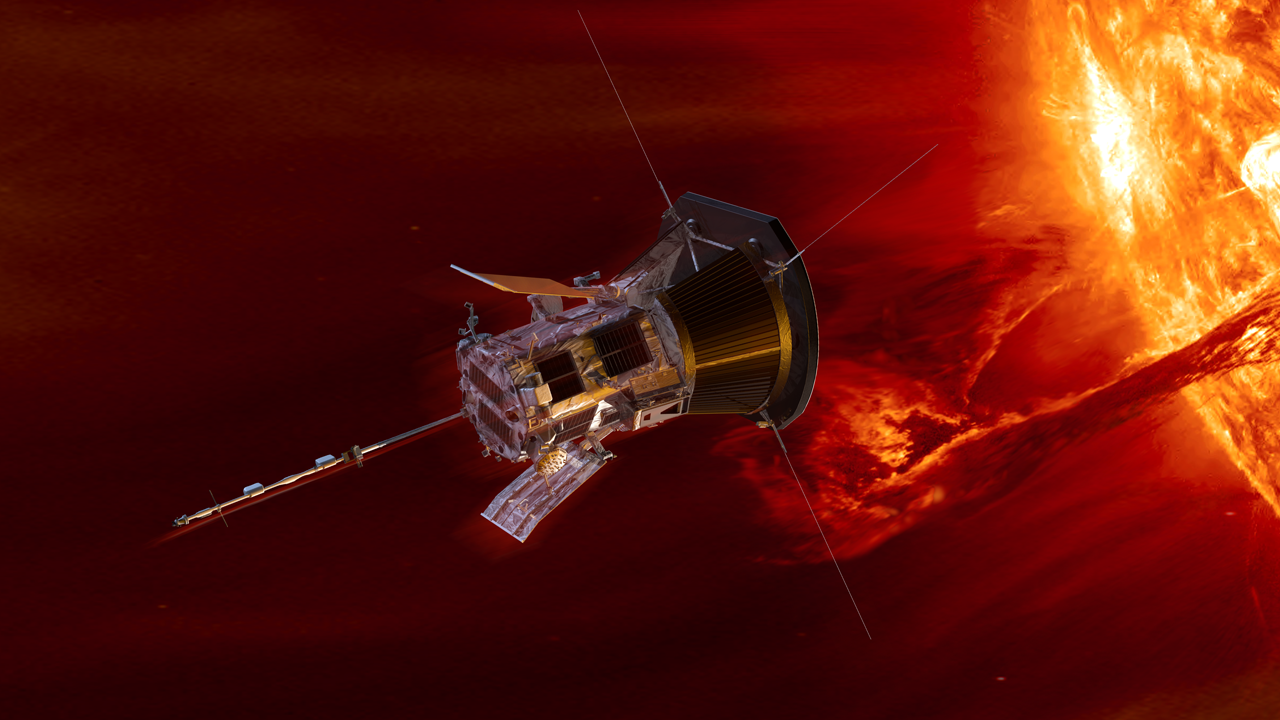
NASA’s Parker Solar Probe achievement has triggered the question of whether robots will replace humans in space exploration. In 2018, Parker Solar Probe was launched for the sun and, on Christmas Eve, was its closest approach of 3.8 million miles from its surface.
The probe was built to persist through a whopping temperature of 1,400 degrees Celsius and heavy radiation to be able to get closer and closer to the sun. Even though a 4.5-inch thick carbon composite shields the probe, it is meant to get in and out of the sun’s outer atmosphere, the corona, to help scientists on Earth develop a better understanding of solar winds and space weather. The BBC reported that it would travel faster than any man-made object, flying at 430,000 mph. As it moves closer to the sun, the probe experiences a gravitational pull, allowing it to travel at incredible speed.
In light of an achievement like this, scholars like Andrew Coates and Martin Rees mention that robots are cheaper and require less funds than a mission with humans in space. The development pace for robots is much faster, and they can travel faster and further and achieve tasks more efficiently. As Dr Kiri Wagstaff, a planetary scientist, stated,
“Humans get tired and lose focus, but machines won’t.”
Robots have already proven their worth in space exploration. Rovers on the moon and Mars conduct automatic tasks to transmit data back to Earth without scientists’ supervision. Humanoid robots like Valkyrie and Robonaut, on the other hand, can perform maintenance tasks.
On the contrary, Dr Ian Crawford, a planetary scientist, highlights the versatility of humans compared to robots and how they are able to overcome unpredictable challenges, echoing that humans are more adept at complex missions that need creativity.
Humans also can better inspire people in space exploration, and people feel more connected to achievements for human-centred missions. Besides inspiration, humans play a major role in space research. Instead of completely replacing humans in space exploration, robots are able to complement humans as they can take over specific tasks that will free up human beings’ time to contribute more to the mission. A sentiment that Dr Kiri Wagstaff stresses.
Dr. Weinersmith mentioned that humans are “hard and expensive to keep alive in space.” Author Samantha Harvey wrote,
“A robot has no need for hydration, nutrients, excretion, sleep… It wants and asks for nothing.”
These statements highlight the cost-benefit analysis of using robots and AI, but Leroy Chiao, a retired NASA astronaut, stated, “Humans relate when humans are doing something.”
As space exploration continues to push boundaries, robots are proving to be indispensable partners in understanding the universe, and their durability allows scientists to research regions too extreme for human survival. However, creativity and adaptation remain crucial. Humans and robots together form a collaborative partnership that can achieve goals neither could accomplish alone. As our sights are set on Mars, moons and beyond, the question shouldn’t be whether robots will replace humans but how they will work together to make the impossible possible.