

Author’s Note: All persons named in this story have agreed to be named.
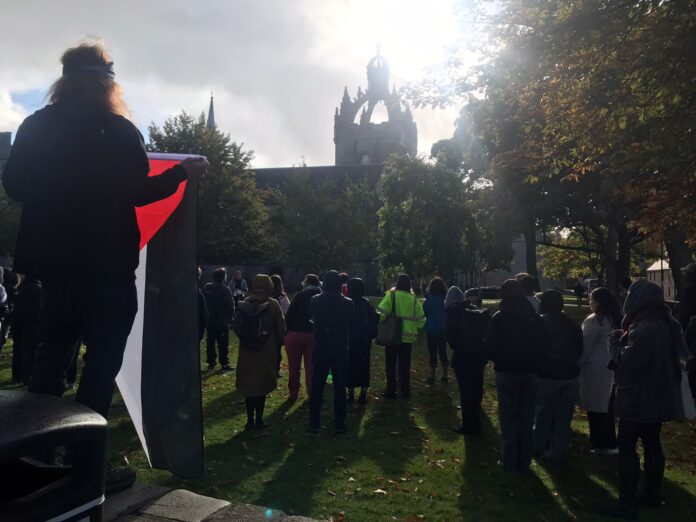
Ayah, 22, then-President of Palestine Solidarity Society (PSS) faced investigations for a statement challenging University of Aberdeen (UoA) for welcoming a former Israeli soldier as a student.
A separate investigation ordered Sanaa, ‘Scarf for Gaza’ fundraiser and ex-University Senator, to attend antisemitism training and delete several Facebook posts.
Both were investigated under the Code of Practice on Student Discipline (Non-Academic).
Ayah’s case
Weeks before graduating with a degree in Education, Ayah has been accused of committing misconduct as a representative of PSS for a post in which the society accused a Students Supporting Israel (SSI) event of “whitewashing war crimes.”
The SSI panel was a collaboration of students at Ohio State and University of Aberdeen
discussing ‘the impact of head trauma on Israeli Defense Forces (IDF) personnel’.
It was co-hosted by Adam, 21, a Law & Politics student at UoA who discussed head trauma he sustained while serving in the IDF.
The event was aimed at Israeli-supporting students, but Pro-Palestine activists entered the public Zoom call en-masse, waving flags and holding up banners with slogans.
Afterwards, PSS posted an Instagram statement accusing asserting the event was “not in our name” and labelling Adam as “a pawn of genocide.”
The post indirectly alluded to Adam’s identity by stating his degree subject and year of study – information which Ayah says he shared about himself in the panel discussion. Calling the ex-IDF soldier “a potential war criminal,” PSS asked, “is this someone the University should welcome?”
After Adam reported the post to the Students’ Union (SU), PSS unpublished the post, and the SU Chief Executive formally referred investigation proceedings to UoA.
Following an investigation, University officials concluded the post was “threatening and intimidating.”
“Misconduct had occurred,” reads the investigation, by “the social media posts made by the PSS following the Ohio State University event” and “the allegations made against the University of Aberdeen regarding its involvement in the event.” It is unclear what allegations PSS made against the University of Aberdeen.
Ayah shared: “Those who reported the statement have been looking for something to report us on.
“The investigation came at one of the most critical points in my academic journey. I was working on my dissertation and managing placement full-time — all while being scrutinised for standing up for a cause I believe in. It didn’t just affect my studies; but at that time my health was declining significantly. I wasn’t silent because I had nothing to say — I was just trying to survive a process that felt punishing for speaking up.”
Adam told The Gaudie that he perceived the PSS post as “unacceptable”, “a direct attack” on him, and a “blood libel”. The former IDF soldier thanked the SU’s student officers “for their support” but was disappointed by the outcome of the University’s investigation: “They allowed my safety to be breached and allowed my skin and blood to be exposed on campus. What more needs to happen for the University to realise the situation is serious?”
Ayah responded: “Our intention was never to put any individual in danger – that wouldn’t help our cause at all. None of this was done in vain to make somebody feel unsafe.”
Asked how the University should respond to students who are former IDF soldiers, she responded: “I think the University need to check who they are welcoming.”
A UoA spokesperson shared: “The [panel discussion on IDF head trauma] was not organised by the University. We responded to a complaint about online posts and followed established policies. We support and promote the right of all members of our community to have a voice, however our campus must be a safe space for all and we will take appropriate steps to investigate reports of concern where needed.”
Sanaa’s case
Sanaa, a PHD student of engineering at the time of investigation, stood as a prominent student encampment member last summer, and raised University Senate motions condemning Gaza violence and calling for freedom of expression.
A University staff member who searched Sanaa’s public Facebook page screenshotted several posts and emailed them to the Principal alleging antisemitism.
One screenshot shows a reshared image of a Star of David symbol intertwined with a Nazi swastika, accompanied by the caption “The irony of becoming what you once hated.”
The investigation outcome reads that “the post, [alongside Sanaa’s] response at the meeting that the current behaviour of Israel in the ongoing Israel – Palestinian conflict is the same as what the Nazis fell within examples of antisemitic behaviour.”
Another post makes a “2024 wish” for “the Zionist Israeli state to vanish,” for post-1914 settlers to “leave Palestine,” and for “original Palestinians (Muslims, Jews and Christians) to live in peace.”
The investigation report says: “[Sanaa]’s response that those who are offended by these posts should come to her so that she could educate them indicates the reported party fails to recognise and appreciate the antisemitic nature and negative impact of the posts on some members of the university community.
“The Investigator concludes [the images] have antisemitic connotation based on the definition and examples of antisemitism by IHRA and JDA, could be found to be offensive to some members of the university community and wider public, and thus constitute, on the balance of probabilities, misconduct under the Code.”
In 2022, the University adopted the Jerusalem Declaration of Antisemitism (JDA) in place of the International Holocaust Remembrance Alliance (IHRA) guidance. The University Senate had voted on the new definition in a bid to protect the freedom to criticise the Israeli government. The University did not answer The Gaudie’s question on why University investigators applied the replaced IHRA definition.
An open letter to the National Union of Students (NUS) signed by PSS also implores NUS to revoke use of the IHRA definition as “pro-Israel groups weaponise the IHRA definition of antisemitism to silence and intimidate students and staff.”
At her investigation hearing, Sanaa invited an academic for support. When asked if the posts caused offense to them as a Jew, they said “no”.
Sanaa denied charges of antisemitism and accused the University of “clear targeting and persecution of students who stand for Palestine.
“As an Iraqi Muslim woman, refugee and having lived under Saddam’s authoritarian regime, I have never experienced this level of oppression and harassment.
“I am trying to stop a genocide and to save a nation – it’s an important cause that I am willing to face difficulties for.”
A spokesperson for The University of Aberdeen said: “We do not comment on individual student matters.”
The Students’ Union did not respond for comment for this article.

Living an era where war criminals are protected while peaceful human rights activists face legal consequences for exposing war criminals and saying NO TO THE GENOCIDE