
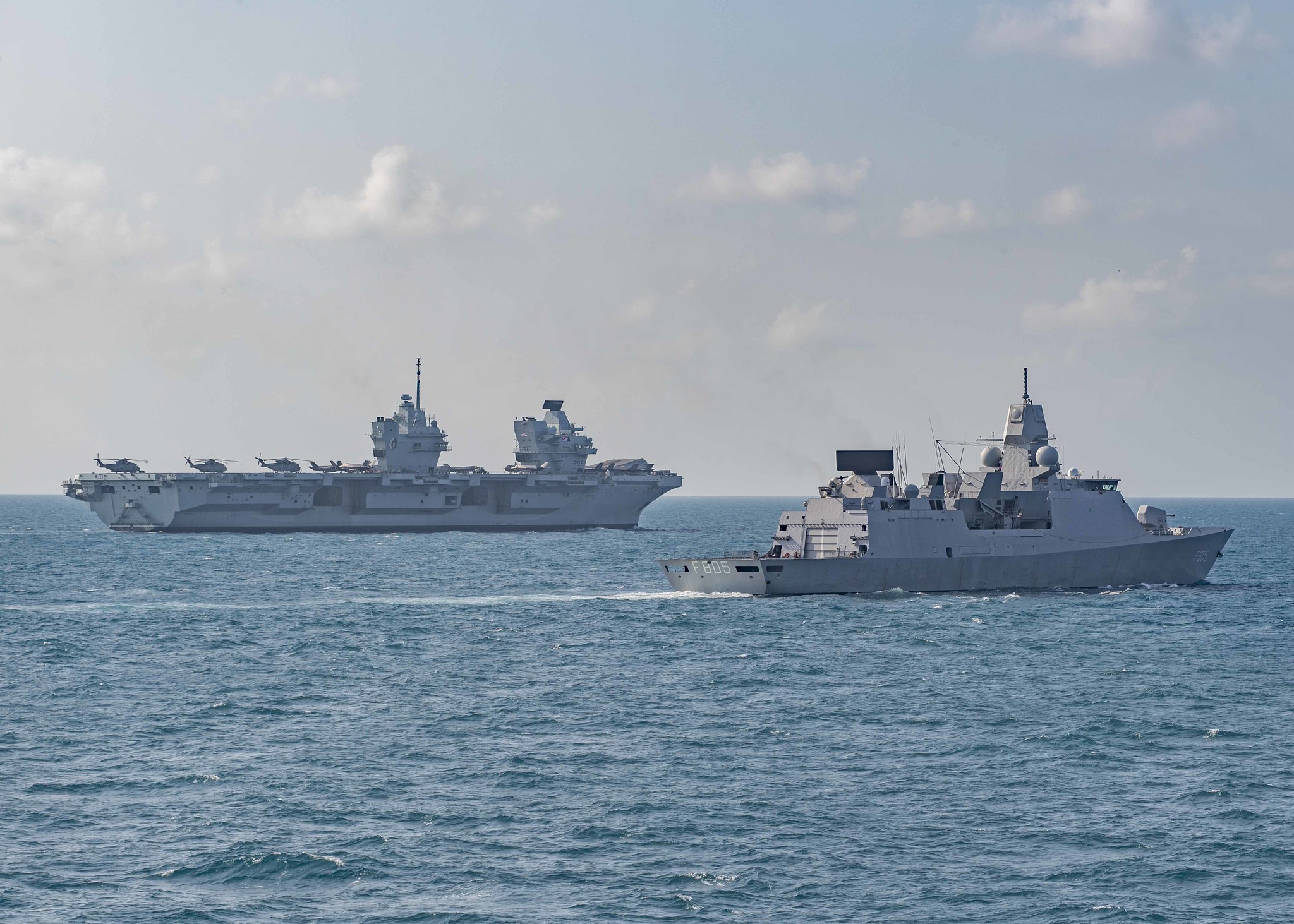
November’s Joint Expeditionary Force (JEF) summit aboard UK aircraft carrier HMS Prince of Wales in Oslo saw the signing of the Northern Navies Initiative. This will see the JEF’s naval forces move to become interchangeable, building on established interoperability.
The JEF is a military partnership that was established in 2014 as a complement to the wider NATO alliance.
Proposed by the head of the Royal Navy, First Sea Lord Gwyn Jenkins, the navies of the ten JEF nations should operate as one to support collective security across the Baltic Sea, North Sea, North Atlantic and High North. Led by the UK, the Joint Expeditionary Force also includes the Netherlands, Denmark, Latvia, Lithuania, Estonia, Finland, Sweden, Norway and Iceland.
To achieve this “interchangeability”, the JEF navies will align their training, procedures, and operational planning to reduce the differences between them. This will also involve investing in similar technology, platforms and systems.
A series of recent agreements between the UK and Norway will see Norway acquire five UK-made Type 26 Frigates identical to those being built for the Royal Navy and the UK and Lithuania buying Norwegian-built patrol vessels.
UK shipbuilder Babcock International is also pitching its Arrowhead 140 frigate design to Denmark, which the UK’s Type 31 Frigates are also based on.
Norway and Denmark have also expressed interest in the UK’s Hybrid Navy concept, which was a key element of the Defence Investment Plan, announced in July. Hybrid Navy is the UK’s plan to build crewless warships to detect and defend against missiles and drones, as well as hunt for submarines.
The Netherlands is developing a similar concept independently, while the UK has joined the Dutch programme to build new transport ships for amphibious landings.
Read more: Is the UK doing enough to improve defence?
All ten JEF navy leaders signed the Northern Navies Initiative while aboard the UK’s flagship HMS Prince of Wales during a visit to Oslo, Norway. This came shortly after the aircraft carrier participated in NATO’s Exercise Neptune Strike alongside French, British and Norwegian warships in the North Sea.
Of course, closer cohesion between the JEF nations comes due to the increase in Russian grey-zone attacks and airspace violations across Europe since its full-scale invasion of Ukraine in 2022.
The JEF’s response option was first activated in December 2023 after the Balticconnector pipeline, running between Finland and Estonia was damaged under suspicious circumstances. Several ‘response options’ have been developed by the JEF which can be activated at short notice to respond to a variety of threats or an attack.
Despite its leadership role within the JEF, it was recently reported in Defence Eye that the French Navy invited its Spanish, Italian and Dutch counterparts to discuss how to defend the Atlantic with a declining Royal Navy.
The Royal Navy’s doctrine is for a fleet of thirteen frigates which form the backbone of its fleet, however currently only five are in operation, with this number expected to drop further before rising. Delays in the arrival of replacement frigates will not see the force return to thirteen until the late 2030s.
Further criticism has targeted the UK’s fleet of attack submarines, of which typically only one is at sea despite six being in commission.
The First Sea Lord has promised the Royal Navy will reach “warfighting readiness by 2029”. Plans like Hybrid Navy aim to bolster the limited numbers of available warships and submarines in service to make the fleet more able to meet the rising demands of an increasingly dangerous world.
More from the author: US First Lady secures limited ceasefire in frontline city Oleshky