

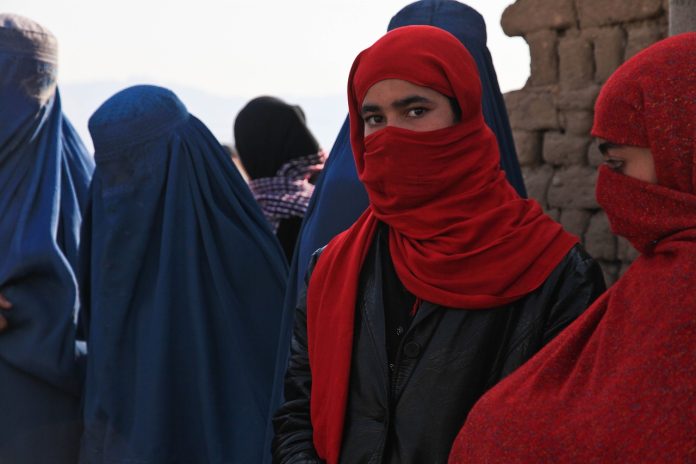
On Monday the 28th October, the Afghanistan Minister for the Promotion of Virtue and Prevention of Vice had a new restriction on women’s behaviour. In Minister Khalid Hanafi’s message he stated “Even when an adult female prays and another female passes by, she must not pray loudly enough for them to hear.”
“These are new rules and will be gradually implemented, and God will be helping us in each step we take,” he followed.
Due to the fact the Taliban have banned living beings from being broadcasted, the announcement was delivered through a voice recording.
“A woman’s voice is considered awrah,” the Minister stated. In Islam ‘awrah’ is used to describe any part of the body that is not allowed to be exposed to those who shouldn’t see it, and is often employed in the Quran in contexts of privacy and spaces of vulnerability. The Taliban are often criticised for their interpretation of Islam as being untrue. Human Rights activists in Afghanistan have warned that this is effectively banning women from speaking or holding conversations with one another.
“Whatever he says is a form of mental torture for us,” an Afghan woman in Kabul stated.
This is the newest restriction in a string of women’s rights restrictions since the Taliban took power in August 2021. These restrictions have sparked fear among human rights activists who are concerned about the livelihood and safety of women in Afghanistan. Women have already been ordered to cover their faces and refrain from speaking in the presence of men who are not their husbands or close relatives. Moreover, women are told not to speak loudly in the home, to ensure their voices are not heard from outside. The Taliban has said that the punishment for being caught doing any of these is imprisonment.
This comes after the Taliban Supreme Leader vowed to start stoning women to death in public for adultery, in March this year. The Taliban claim that they represent Allah and that criticism from Western ‘democratic principles’ represents satan. Moreover, the Taliban have dissolved the Western-backed constitution of Afghanistan and replaced the laws with a fundamentalist interpretation of Sharia law, which is the system of Islamic law.
Reportedly, under the Taliban rule, there has been an increase in suicide among women, who are experiencing immense isolation that is enforced upon them. A UN survey released on the 5th November has highlighted the impact that the Taliban has had on women’s access to humanitarian services. They label it as ‘at risk’, highlighting that 49% of respondents reported that the Taliban restrictions prevent women from receiving protective services and emergency assistance. Moreover, organisations have also reported that channels for reporting sexual abuse or exploitation have been limited – 45% of organisations identify this as a major concern. Moreover, for the third year in a row Afghanistations university exam registration has opened with female applicants barred from registering.
Before the Taliban took back power in 2021, around 3.5 million girls were enrolled in school and women made up 28% of Afghanistan’s Parliament. These numbers are back down to zero, in what has been described as a “gender apartheid”. The consequence of this is predicted to be catastrophic economically for Afghanistan, with continuing cycles of poverty, and limiting women’s contribution economically and socially. From the Women Peace and Security Index 2023/24, Afghanistan has been ranked 177/177 globally.
Canada’s special envoy for Afghanistan has said that Canada, Germany, the Netherlands and Australia have all formally notified the Taliban of their intent to pursue discussions on accountability. They will potentially bring them in front of the International Court of Justice, to discuss human rights abuses, particularly the ones that are targeting women.
The Taliban have expressed a desire to be accepted into the International community. They have appealed for global recognition, financial support and relief from sanctions. However, it is clear that there will be no compromise when the Taliban continue to violate values such as women’s rights and the expression of freedom. Afghan women’s rights activists have also vocally opposed this, urging international bodies to take legal action instead.
These restrictions since 2021 came as no surprise to Afghan women, who experienced the same in September 1996. The Taliban’s 5-year rule from 1996-2001 stripped women of the right to education and employment and implemented a strict dress code. The legacy and memory of these times is a significant contributor to the mass fleeing of the country when the Taliban regained control in 2021. Reportedly, by the end of 2021, there were 2.7 million Afghan refugees globally, highlighting the scale.
At the U.N Headquarters in September this year, Meryl Streep spoke out against the abuses of human rights the Taliban have committed. “Today in Kabul, a female cat has more freedom than a woman. A cat may go sit on her front stoop and feel the sun on her face. She may chase a squirrel into the park. A squirrel has more rights than a girl in Afghanistan today because the public parks have been closed to women and girls.”
The scale and atrocity of the rights cannot be measured and felt by those in democratic societies. Only the women in Afghanistan can understand the terror and isolation this causes, having to live through it. Khalid Hanafi has been called out previously for his reign of terror and accused of using intimidation towards women and girls.
Moreover, international aid has been criticised, for having a tendency to blame Islam. Jennifer Fluri, who is a professor of geography, has highlighted that America and other countries often view the Taliban as an ‘issue of Islam’, which is not the case. She highlights that the Taliban see women as easy targets, and implement these laws in order to gain control. Although the Taliban reference the Quran and claim it is the teachings of Allah – they are seen to interpret these teachings to fit their own narrative, and not what they were originally intended for.
