

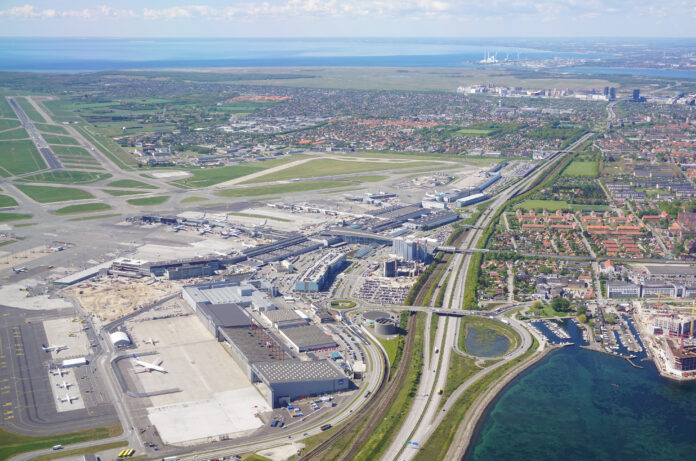
Several Danish airports have been forced to close due to unidentified drone activity, suspected to be the actions of Russia. On the 22nd of September, several large drones were spotted over Copenhagen airport, with Danish authorities stating the drones were too large to be hobbyists. The airport was closed as a precaution.
Oslo airport suffered disruption due to suspicious drone activity over Norway the same day. Further drone sightings that week forced the closure of four additional airports across Denmark’s west coast. These included Aalborg and Skrydstrup, two major air force bases. Additional disruption was caused on Friday with drones near military sites. Denmark has now banned civilian drone flights outright, to regain control over its airspace ahead of the upcoming European Union summit in Copenhagen.
This disruption comes after over twenty Russian drones flew into Polish and Romanian airspace through western Ukraine earlier in the month. Estonia also reported several Russian military aircraft entered its airspace over the Gulf of Finland. Both Poland and Estonia initiated NATO’s Article 4 – calling for dialogue with the North Atlantic Council. NATO has also launched Operation: Eastern Sentry to strengthen its defensive posture across the alliance’s Eastern Flank.
It is suspected that the drones causing disruption in Denmark are also of Russian origin, and Danish authorities are investigating whether Russian commercial ships sailing around Denmark are being used as launch platforms as they enter or exit the Baltic Sea. The Russian Government has previously been accused of using its civilian-operated ‘Shadow Fleet’ to disrupt NATO infrastructure.
Russia has dismissed any allegations of involvement in the drone activity, describing the rumours as “absurd speculation.” Speaking at the UN Assembly, Foreign Minister Sergei Lavrov insisted that NATO was obsessed with vilifying Russia, and of convincing its population war with Russia is inevitable. Ukrainian President Volodymyr Zelenskyy commented on the drone activity on his X account, stating “all of Europe is under Russia’s potential aggressive actions.”
Since its full-scale invasion of Ukraine in 2022, several Russian commercial ships have been suspected of damaging seabed pipelines and internet cables underneath the Baltic Sea. In one case, Finnish authorities found spy equipment aboard the Russian oil tanker MV Eagle S after the vessel was seized for investigation. Given this history, Denmark has not ruled out that the drones may have come from the Russian vessels which regularly pass near or through Danish waters to access Russia’s Baltic ports.
A Russian Navy transport ship, the RFS Aleksandr Shabalin, has also been reported loitering just outside Danish territorial waters in the Baltic Sea, during the time of drone activity above Copenhagen. NATO reinforced its sea and air patrols in the Baltic Sea after a wave of seabed infrastructure disruption in 2024, and member states typically monitor Russian military ships transiting through or near their territorial waters.
With this current phase of what NATO suspects is Russian military-related activity, the alliance’s Article Five deterrent may prove more crucial than ever. Article Five states that an attack on one member state will be perceived as an attack on all. The only time Article Five has been triggered was after the September 11 terrorist attacks against the United States in 2001.
In response, US President Donald Trump appears to have performed a U-turn on his Europe and Ukraine policies and has encouraged his NATO allies to shoot down any Russian aircraft or drones that enter their airspace.
A German air-defence frigate has been sent to Copenhagen to bolster security ahead of the EU Summit, and Danish authorities have introduced new measures to help secure key infrastructure and assist investigations.
