

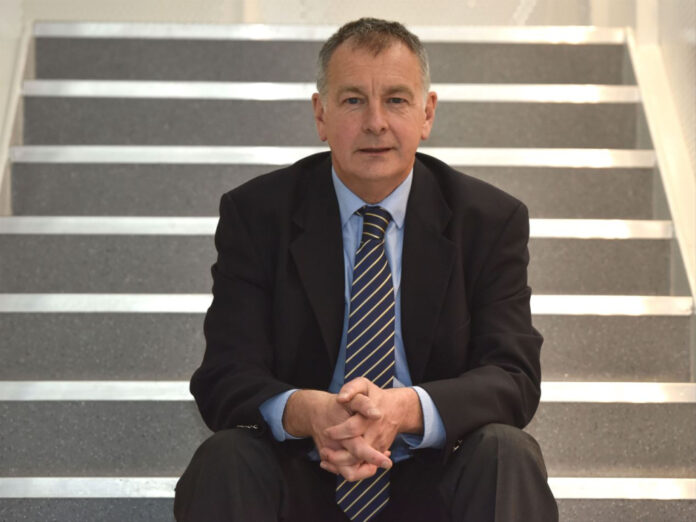
The full extent of an Aberdeen University professor’s links to oil and gas giants have been revealed after he published a research paper calling for a “bespoke fiscal regime” for energy giants operating in the North Sea.
This comes as he lobbies the UK government to reopen drilling in the Rosebank and Jackdaw oil and gas fields.
Leading the University of Aberdeen’s Centre for Energy Transition, Professor John Underhill has been seen meeting with politicians and lobbying the government amid speculation that the Jackdaw oil field could be reopened.
He was seen meeting Conservative MP Andrew Bowie with SNP MSP Jack Middleton in the Sir Duncan Rice Library to “discuss issues relating to energy and electricity.” He has also written articles in the Financial Times and The Scotsman, as well as multiple articles for the Press and Journal, with the most recent titled “Why Jackdaw gas field should be approved”.
What links does Professor Underhill have to the oil and gas sector?
Professor John Underhill is part of the Subsurface Task Force, a forum that provides the North Sea Transition Forum with expertise in energy resources and security.
The forum provides the government with “leadership in the offshore oil and gas industry” and is made up of senior cabinet ministers, industry leaders, and task forces.
25 energy companies are stakeholders in the Subsurface Task Force, including the likes of Shell, BP, Equinor, and Dana Petroleum.
Underhill was also a board member of the Scottish Energy Forum until 2017. It is made up of members such as oil and gas production firm Serica Energy.
What links does Underhill’s research paper have to the sector?
In June, a Press and Journal article titled ‘Tax breaks call to spark Shetland oil and gas bloom’ cited an Aberdeen University research paper headed by Professor Underhill. The Telegraph also cited the same report in August.
This paper was further picked up by Conservative leader Kemi Badenoch whilst campaigning for the Aberdeen South by-election, which was won by Conservative MP Douglas Lumsden.
However, the geology paper, which called for tax reliefs for drilling projects within the Rosebank and Jackdaw fields, caused concern due to its authors’ ties to several leading oil and gas companies.
70% of the authors have worked for companies that would benefit from the “bespoke fiscal and economic regime” that the paper calls for. These contributors either work for Shell, BP, or Equinor.
The paper was published the day before Shell and Equinor moved their 250-metre-long vessel, known as Petrojarl Rosebank, above the Rosebank basin, to apply pressure to the UK Government.
One leading environmental charity said: “It’s not surprising they appear loose with the facts.”
Who were the authors of the paper?
Underhill’s co-author Lucinda Layfield is the current asset manager for Equinor, having previously held titles such as “asset geologist for Rosebank Field development” and “project manager.”
Ben Kilhams has been an employee of Shell for 17 years, now holding the title of “senior exploration geoscientist”. He is also an honorary research fellow at the university and was cited as a contributor to the paper.
Equinor owns 80% of the Rosebank oilfield, located within the West of Shetland region. Along with Shell, the company has pursued a joint venture for UK oil and gas production called Adura.
Also amongst the authors are Douglas Watson, a geologist at BP, and Stuart Archer, who was a geology lead at Harbour Energy until last month. BP and Harbour Energy both operate in the Clair, Schiehallion, and Solan oilfields which are in the same basin as Rosebank.
Co-authors Jens Beenfeldt and Eric Mueller are both geoscientists at the firm that sells data and intelligence to UK and Norwegian oil and gas companies.
Outside of the authorship, the paper was published by the Energy Geoscience Conference. It was presented, published, and edited by Graham Goeffry who owns Soliton Resources Limited.
Goeffry founded Soliton Resources in 2017, whose business model involves obtaining licences for potential unexplored oil fields.
In 2019, Equinor UK bought an 85% stake in Soliton Resources and has so far invested £25 million into Goeffry’s company.
Tessa Khan, Executive director of environmental charity Uplift, stated: “The oil and gas sector has a long history in engaging third parties to influence public debate.”
“Providing expertise to support policy discussions is one thing; advocating in ways that primarily serve industry interests is another.”
The university has refuted any claims that the paper was influenced by any of the companies. It said: “The findings are objective and evidence‑driven and the paper was researched and written completely independently of any private companies.
“It is commonplace for representatives of private companies to co‑author research papers, particularly when they contribute specialised expertise, data, or access to technology.”
Underhill added: “An energy transition and net zero future is the stated goal of the UK Government, and our university research aligns with accelerating the energy transition.”
The paper also makes clear that each author contributed to the paper in their own time.
When asked for comment, Professor Underhill asked the question: “Should we rely upon imports like Liquid Natural Gas (LNG), which carries a far higher carbon footprint and is significantly worse for the global climate, or from the UK production which is highly regulated and lower carbon intensity.”
The University has previously taken donations from energy companies to fund research. As revealed by a Freedom of Information request, Shell has funded research grants of up to £300,000.
The University’s Centre for Energy Transition, which Underhill leads, has also been granted funding from oil and gas firms such as Equinor and BP.
In response, Underhill commented, “An energy transition and net zero future is the stated goal of the UK Government, and our University research aligns with accelerating the energy transition.”
