
Lots of new babies have been born at the Royal Zoological Society of Scotland (RZSS)’s Edinburgh Zoo over the last few months. This is fantastic news for wildlife conservation. Here’s a wee guide on the new arrivals!
Snoot the Giant Anteater Pup
Edinburgh Zoo’s giant anteater pup, Snoot, was born on the 5th of April to parents Gizmo and Zeferino. On the 10th of August, the zoo announced the gender, revealing him to be a little boy. He can be spotted in the giant anteater habitat on mum Gizmo’s back. Baby giant anteaters do this until they are about 10 months old to hide from possible predators, and during the search for food, as well as to strengthen the connection between mum and baby. Snoot’s birth is great news for the conservation of this vulnerable species.
Giant anteaters can grow to eight feet. Lacking teeth, they use their long tongues (about two feet long!) to help them eat their food, which consists mostly of ants and termites. Spines on their tongues help them eat, and they use the roofs of their mouths to squish their food. Then, their muscly stomachs grind the food down inside them. Isn’t that cool?
Gentoo and Northern Rockhopper Penguin Chicks
Gentoo and Northern rockhopper chicks began to hatch in the zoo in April. They are tiny when they first hatch; gentoo chicks reportedly weigh ‘roughly the same as a bar of soap’ and Northern rockhoppers ‘the same as a small kiwi fruit’. Northern rockhoppers are an endangered species, which makes the arrival of these new babies even more exciting! You might be able to spot the chicks with their parents at Penguins Rock in the zoo.
The quickest of all penguin species, gentoo penguins can swim up to 22 miles per hour. They construct their nests from little stones, and the females and males take turns to incubate the eggs, something that female and male Northern rockhoppers do too. Northern rockhoppers swim roughly 4 miles per hour (giving some perspective on how speedy gentoos are) and make their nests in long grasses. They have distinctive bold yellow feathers above their eyes and are the smallest penguin species at Edinburgh Zoo.
Baby Bru the Capybara
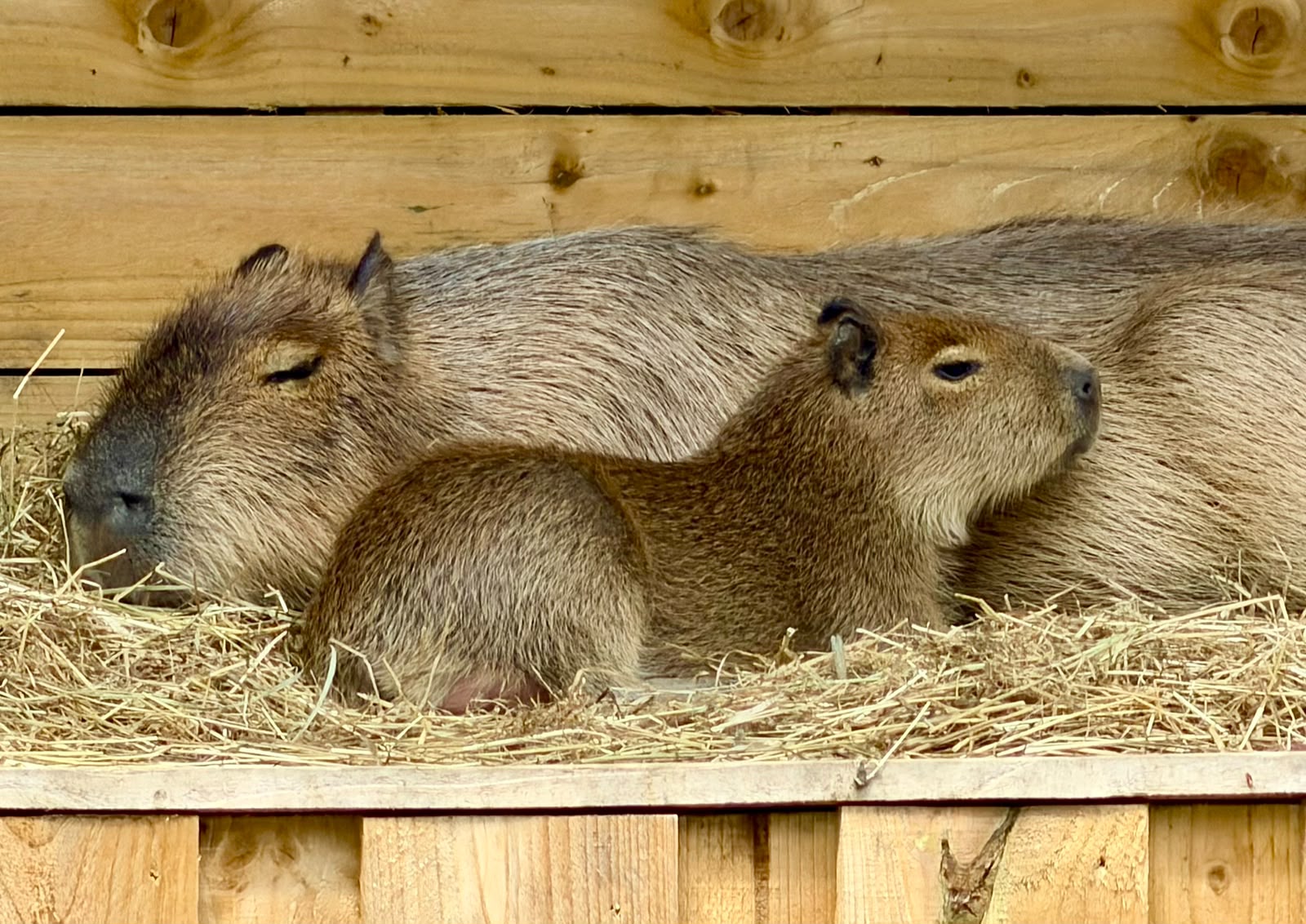
Adorable baby Bru is the first Scottish capybara pup born in 18 years. He is now the fourth capybara at the zoo, joining his parents Luna and Rodney, and the other resident capybara, Cali. As of late July, he weighed 7 kg, roughly equivalent to 19 cans of Irn-Bru (according to zookeepers) and is a healthy weight for his age.
Capybaras are the largest living rodents on Earth and can run up to 22 miles per hour! Who do you think would win in a race between a swimming gentoo penguin and a running capybara? Often compared to guinea pigs in appearance, the two species are distantly related and are both part of the Caviidae family of native South American rodents. Capybaras are semi-aquatic and swim with only their nostrils poking out of the water. This is useful to conceal themselves from predators. They became popular on the internet for being so calm (and, of course, for being very cool and cute!).
Atty the Two-Toed Sloth Baby
Atty, named after Sir David Attenborough, was born in May to Feiro and Nico who are both six years old. Significantly, he is the first ever baby sloth to be born in Scotland! Atty will cling to his mum’s stomach for up to six months.
Two-toed sloths sleep, eat, mate, and give birth upside down. They have two clawed toes on each front foot and three on each back foot, as opposed to three-toed sloths who have three clawed toes on each foot. Two-toed sloths use their claws to cling onto tree branches as they hang upside down. They are omnivores but mostly eat plants. Interestingly, only two-toed sloths are omnivores, sometimes eating small lizards, whereas three-toed sloths are herbivores, only ingesting leaves.
Piper the Pygmy Hippo Calf
Piper the pygmy hippo calf was born to Gloria and Otto on the 31st of July and is the latest birth at the zoo. She is still very small (weighing just below 5.5 kg on the 7th of August), but the nutrients in her mum’s milk means that she will grow speedily. Her birth was a surprise to zookeepers, as they expected her to be born in mid August. They named her Piper because of the bagpipe-like noises she makes.
Pygmy hippos are an endangered species found only in West Africa, where they live in swampy forests or rivers. They do not go in the water as often as common hippos, as they devote more time to roaming tropical rainforests. Despite being five-times smaller than common hippos, pygmy hippos weigh as much as male lions! Although they are heavy, they are still fast, averaging 18 miles an hour, similar to humans.
To find out more about these lovely new babies, check out Edinburgh Zoo’s social media accounts and their website: https://www.edinburghzoo.org.uk/