
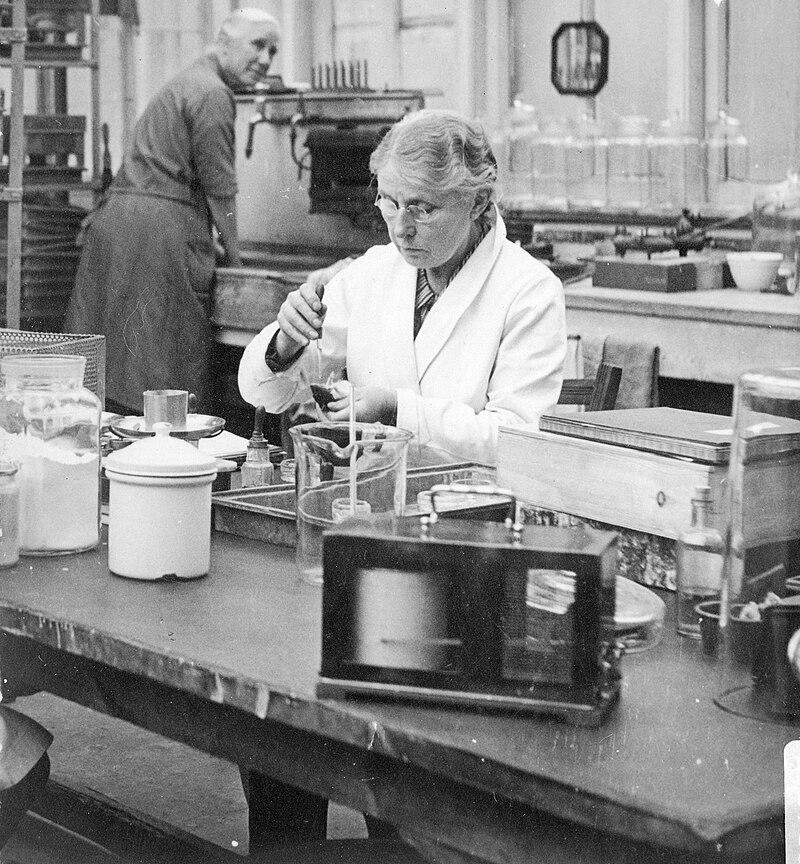
In March, the Royal Society celebrated the 80th anniversary of the election of the first female fellows, Kathleen Lonsdale and Marjory Stephenson. These women were awarded the fellowship for their pioneering work in crystallography and biochemistry, which laid the foundations for modern organic chemistry and biochemistry. In honour of these women, the Royal Society has released two documentaries on YouTube talking about these women’s lives and their research.
The Royal Society is the oldest scientific academy in the world, having been founded in 1660 as ‘the Royal Society of London for Improving Natural Knowledge’. Every year, the Royal Society elects fellows; these are scientists and engineers who have made ‘a substantial contribution to the improvement of natural knowledge, including mathematics, engineering science and medical science’. Famous previous fellows have included Isaac Newton, Charles Darwin, Alan Turing, and Stephen Hawking.
Kathleen Lonsdale (1903 – 1971) was a crystallographer who discovered that benzene is a flat ring. Crystallography is the study of the atomic structure of molecules using X-rays. The discovery of the structure of benzene was an important finding. It has helped to lay the foundations for modern organic chemistry, which relies on benzene’s unique structure in the creation of polymers and pharmaceutical drugs. Another contribution to her fellowship award was the advances in crystallography due to her research.
Kathleen pioneered educational equality; she fought and campaigned for more women in science. She was the first female professor at UCL and the first female president of the British Association for the Advancement of Science. UCL awards the Kathleen Lonsdale Medal to students who have created outstanding work.
‘‘No person shall be refused admission to the laboratory as a worker or as an assistant to a worker by reason of his or her nationality or sex.”
Marjory Stephenson (1885 – 1948) was a biochemist who was the first person to isolate enzymes from a bacterium. The enzyme in question was lactic dehydrogenase (LDH), which is involved in cell metabolism and is present in bacteria and animals. This research was the start of further enzyme research and extraction; from these findings, the concept that enzymes were biological catalysts was born.
Stephenson also created a legacy by writing the textbook Bacterial Metabolism, which was a foundational textbook for generations of biochemists and microbiologists until the 1970s. She was also a founder and president of the Society for General Microbiology, which created the Marjory Stephenson Prize in her memory.
Since 1945, 261 women have been awarded fellowships. One notable fellow is Dame Sue Black, a Forensic Anthropologist and Aberdeen graduate, who was awarded in 2023. However, according to the Royal Society, only 12% of current fellows are women; regardless, this will hopefully increase as the years go on. In 2024, 90 scientists were elected as fellows; 30% of these were women.
As Isaac Newton said,
‘If I have seen further, it is by standing on the shoulders of giants.’
These pioneering women set the stage for every subsequent woman in science, whether it is physics, biology, or computer science. These giants had to fight to get their degrees and their laboratory positions. We now live in a time where women make up approximately 1/3rd of all STEM undergraduates and postgraduate researchers. While it is important to celebrate the milestones achieved and honour the women who have worked to make STEM a more equitable field, we must also remember how far we still have to go. Even today, our headlines reflect the conflicting views on women’s place in STEM and how many are not only fighting for equality but also to prevent the progress that has been made from slipping away.