
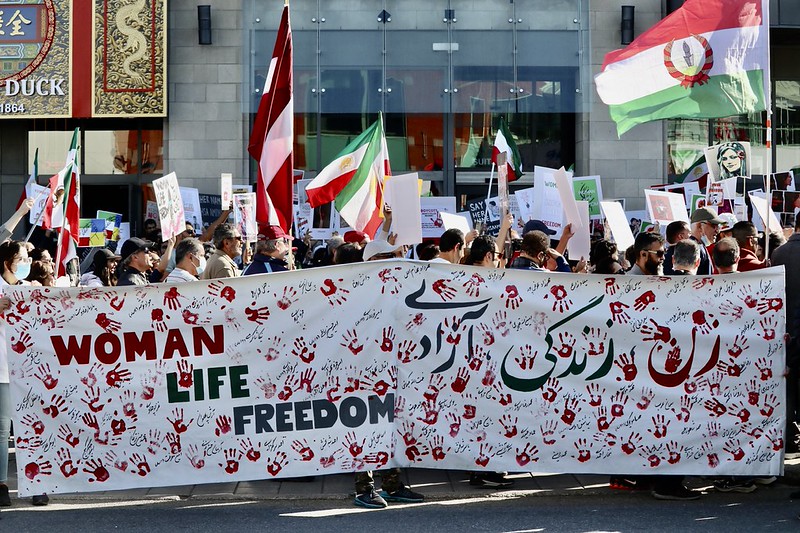
Following the protests in Iran this January, I had the opportunity to speak with an Iranian man who now calls Scotland his home. For the purposes of privacy, he has asked to be referred to as Javid.
Javid spoke to me about growing up in Iran, his fight for freedom and the protests spreading across his home country. Despite the hardship he faced from very early in his life, living under an authoritarian theocracy, Javid remained resilient. He came to the UK in 2022 after he began to fear for his life, having engaged in political activism and in protests following the killing of Mahsa Amini. Originally from the southern city of Ahwaz, Javid now resides in Glasgow. Here, he has built a new life for himself by attending college, going to church, and spending time with friends. Yet, just four years ago, Javid’s life was very different.
Alongside school, Javid started working at age ten to support his family. Being the only other male in the household, Javid brought in some extra money to keep them afloat. Working in Iran was intense, and from a young age, Javid endured manual labour, such as lifting heavy building material. He told me he had no other choice if he wanted a future, “If you have a poor family, or they don’t have enough money, you must go to work.” When he was eighteen, Javid had to enrol in mandatory national service, which lasted two years. For one part of this service, Javid was taught how to use guns. “We were given AK-47s,” he said. He was taught how to take one apart, put one together and how to shoot with one. “They just want to make you ready for war. They just want to use you for war.”
Forced to grow up quickly, Javid expressed that he felt that his generation in Iran was “finished.”
“Just imagine, 18 years in school and work, then two years in the national service – this is twenty years.” Javid said that those young years of his life were “just gone.” Like many people of his generation, Javid says he had lost hope for his own future. He shared that one of his friends committed suicide when he was 17, “He had no hope for the future, for freedom, for life.” Wanting to make sure future generations of Iranians didn’t have to endure what they did, many Iranians take to the streets: “Lots of generations have no hope, because they are depressed. They just want to change it for future generations.”
The story is a little different for his parents’ generation. Fear that has been passed down for decades is not easy to overcome, and they question why their children are suddenly taking to the streets. “My mum asked me ‘why are you fighting in the streets?’” Javid said, and he told her, “I want freedom. We just want a future for other generations.” Javid expressed disappointment with the fact that his family would not join him. He told them,
“If you stay home, the regime won’t be changed. They just kill and kill and kill. You must join me on the streets.”
Even though he is far from home, Javid still takes part in activism where he can, including attending demonstrations in Edinburgh and Glasgow, showing support for the people of Iran. When I asked him how the demonstrations went, he replied, “They were peaceful,” and that “a lot of people were asking about what was happening.” He spoke of a Ukrainian individual he met in college. They often ask how things are back in each other’s home country. Javid says he is apologetic about the Iranian government’s alliance with Russia, the country that invaded Ukraine in 2022, but that she understands it is the government at fault, not the people.
Before the internet was cut, Javid’s friends and family could see what he was posting online. Despite being far away, Javid is still aware of what’s happening in his home country, and it makes him angry, “My sister was happy, because I support them; because she could see that I care about them.” Javid said he didn’t want to be afraid to share his thoughts online,
“These are my words, I don’t want to keep them in my heart.”
With Javid’s family still living in Iran, and the internet being cut, contacting them has proven difficult. Javid told me he was able to reach his mother once, but only for two minutes. He was concerned that the Iranian government could find him and that any longer could put his family in danger. I asked him to tell me more about his family and his home. “The cities are beautiful and historic. Tehran is very new and modern.” Javid told me, adding that he hopes one day I could visit and see his home, and by that time, Iranians would be free. If you’re walking down any street in the city, Javid says it’s likely you will be asked by someone to join them in the home, and for something as ordinary as going to a coffee shop, Javid said Iranians will fight to pay first, even in a group of ten people. “I think this is a good habit.”
“Everyone is warm, and they are very welcoming people. If you come to my city, each day they will invite you for lunch and dinner. For example, today with my auntie, another day my sister, the next day my neighbour. They care about guests coming to our city, you know? We don’t want them to go home and say they [Iranians] are really bad people. We don’t want that, we just want to give you good memories about our city.”
Javid explained how religion was a part of growing up in Iran, and how, from early on in his life, he grappled with the regime’s religious teachings: “They talk about Islam. They say you must, you must, you must. We’re children, we don’t have any choice, and we don’t know exactly what’s going on outside. So we accepted, until we grew up. After that, we can see everything is different. Which God says to kill this person because he doesn’t accept Islam? Why do you kill people?” He said to me, adding,
“And we are just protesting. We are just protesting people in the city, why do you kill us?”
Javid explained how he was taught to think of other countries, like the United States and the United Kingdom: “They said America was bad, but America is good. They told me Britain is bad, but Britain is good. They just want to show us, outside of Iran, that they are very bad people. The media said very bad things about here, but when I came, I saw the people, and it’s very different. People are very friendly, very nice. But in our media, they said that people here were bad. Here, people don’t care about each other or family and they have too much freedom. Many things like that.”
In Iran, all media is controlled by the government: TV, radio and newspaper. But according to Javid, most people are disinterested in these traditional forms of information. Social media and phones, he says, are far more influential. “The media lies, all people from the Middle East are bad, but the Middle East has very good people. The same happens in Iran, we are taught that the West are bad.” Similarly, Javid said there was a growing lack of faith, on top of a growing resentment towards the way Iranians were policed by it: “Right now, many, many people, they don’t believe what they say,” he told me. “Lots of people, not just me, lots of people in Iran, they don’t care about Islam. Like my family, they were very, very Muslim, but now they have changed.”
This kind of defiance does not come without cost. Javid gave me a striking example of policing in the UK compared to his home of Iran. “Here, if something happens and the police are arresting you, they’ll take you to the police station. But in Iran, they can come with normal clothes, like my clothes, and they arrest you – nobody knows where you are. Maybe they will kill you.” He continued, “Sharing and interacting with content on social media can result in death.” Javid said Iranians feared even speaking their mind in their own home. He said his parents’ generation is the most scared, and that this was a fear passed through generations. “They want to control you, you know. They totally want to control you.”
Even though his life was hard, Javid always had the love of his family. Now, so far away from them and with no means of contact, Javid said all he could really do was wait and pray, saying that he had “no more power.” Although deeply upset about the killing of protesting Iranians on the streets, Javid said he knew the government couldn’t just kill everyone. “You don’t have a bullet for all the people.” And he emphasised that the Iranian people have to protest and speak their mind, but at the same time, still worried for his family’s safety. “We don’t know exactly what’s going on with my family. We don’t have contact. We are just waiting, and waiting, and waiting.”
When I asked about his journey to Scotland, Javid started with his last day in Iran. In 2022, Javid had been protesting on the streets after the killing of Mahsa Amini. One fatal night in December, he recalled a companion of his being arrested and shot. Fearing for his own life, Javid made the difficult decision to flee. “I was thinking, ‘my life is in danger, I just want freedom.’” He said to me. He had gone to his uncle’s house, hours away from his own home and the rest of his family, so he was only able to say goodbye over the phone. An arrangement was made after three days with what Javid called a smuggler. He, and around 50 other people, were transported in the back of a van for 12 to 14 days.
It was when Javid got out of the van that he saw the water, and the smuggler demanded that Javid get on a boat. Though he contested that this wasn’t part of the original agreement, Javid was met with threats, and the smuggler brandished a gun at him. The people with him on the lorry joined him on the boat for nine hours, which Javid described as “very thin,” adding, “If there was a small hole, all would die.”
“It’s a really bad memory for me. People were so scared.” Javid, too, was afraid. Most of all, he was afraid he would die out at sea. “Nobody could save us, nobody cared about us.” He told me. He recalled reaching the coast of England, and an Afghan man he had travelled with phoned the authorities. “When he said he had a signal on his phone, it was a big gift for me.” They waited at the beach for the authorities to show up.
But Javid’s journey did not end here; he recalled spending two nights in a police station, and another two in a hotel located in an English city, before being driven to Scotland sometime around 4 am. Javid said he was scared that the regime could still reach him. “It was a very, very hard journey. I don’t know how I can describe it. You don’t know exactly what’s going on, and you miss your family, everything. It really was hard for me.”
When Javid first arrived in Scotland, he was housed in Falkirk, where he stayed for a little over a year before finally being moved to Glasgow. After two years of interviews and living in Scotland, Javid received his visa. Part of what gave Javid hope in his new life was the people he met. When speaking of the relationships he had made since coming to Scotland, Javid expressed gratitude. “If I were alone, I would be really depressed. I might have done something to myself. I had good luck; I have a lot of Scottish friends. They are like family to me.” He spoke particularly fondly of a woman he met while living in Falkirk: “She was like my mum.”
Adjusting to his new life in Scotland, Javid is still motivated by his desire for freedom:“Freedom in life, freedom in religion, freedom in politics – everything.” He emphasised. For Javid, it starts with someone having the courage to care about their country and to fight for freedom. After that, he is sure people will follow.
What a brilliant article and extremely interesting read. Makes you think about things differently. Media and governments are definitely responsible for such a lot of what we are told and led to believe about each other. But we never truly know the daily fight others may be dealing with. Everyone has the right to lead a free life without being controlled, oppressed and living in fear… that’s not a life it’s merely existence.
Very interesting interview, gives a great insight into what has happened and what is currently happening in Iran.
The current Islamic regime are very brutal and are so scared of their own people gaining the freedom they seek, knowing they would be cast out. Well done Emily
Very thought provoking article.
Well written and hopefully makes more people think about the struggles and lack of freedom the people of Iran have to deal with.