
One of the darkest chapters in Scottish history is undoubtedly the witch trials, where thousands of innocents, primarily women, were accused of witchcraft and persecuted between the 16th and 18th centuries.
However, despite the countless atrocities this period witnessed, with at least 1,500 people executed, these events have become a footnote in our history books, while the women who suffered fade in our collective memory.
Worse, it is not only the women who lost their lives hundreds of years ago who have gone overlooked. Human rights violations and abuses stemming from witchcraft accusations persist today, even at home in the United Kingdom.
In fact, over 20,000 documented cases of witchcraft-related harm and ritual attacks were reported in the media between 2009 and 2019 in just 60 countries.
The figures, which the UN believe are significantly under-reported, highlight the morbid reality: at least 5,250 murders, 60 disappearances, 14,700 attempted killings and physical assaults, and 420 reports of trafficking.
Akuah Denteh is one of the 5,250, who is fading into obscurity despite great injustice. July 2025 marked the fifth anniversary of when she was beaten to death in a crowded market in the town of Kafaba, Ghana, after being accused of witchcraft. The brutal attack was captured on camera, and as the footage circulated in Ghana, Africa and the rest of the world, it shocked us, provoked outrage, and became the face of a new call for change.
This change took the shape of the Anti-Witchcraft Bill, a pioneering piece of legislation making witchcraft accusations and abuses illegal. Yet, in 2023, when the bill passed in Parliament, the president refused to give the signature that would make it law. Ghana now has a new president, and the bill is once again up for debate; however, it remains just a proposal for now.
And so, while much of the world stays ignorant, over 500 women and children wait in purgatory to see if this proposal will ever come to fruition, the overlooked victims of the six Ghanaian witch camps.
“People don’t care about alleged witches. Once you are here, you are forgotten.” Sano Kojo, 66, who has been living in a witch camp since 1981.
Within Ghanaian communities, arbitrary, tragic events such as death, illness, nightmares and natural disasters are often explained as a consequence of witchcraft, and vulnerable women are assigned the blame.
“They always have plans of putting allegations against you, especially if you are hardworking and are still strong and doing well as a woman.”
“I refused for the [village] chief to marry any of my daughters. One day, a child got sick in the community, and the chief accused me.” Residents of the Kukuo camp.
Women who are accused of witchcraft are forced onto a grim path. Many are branded as a burden by their families who escort the accused to witch camps in an attempt to distance themselves while those able to stay in their homes are attacked by their community, shunned by their family, and are often killed while police and leaders, leaving them nowhere to turn but the witch camps.
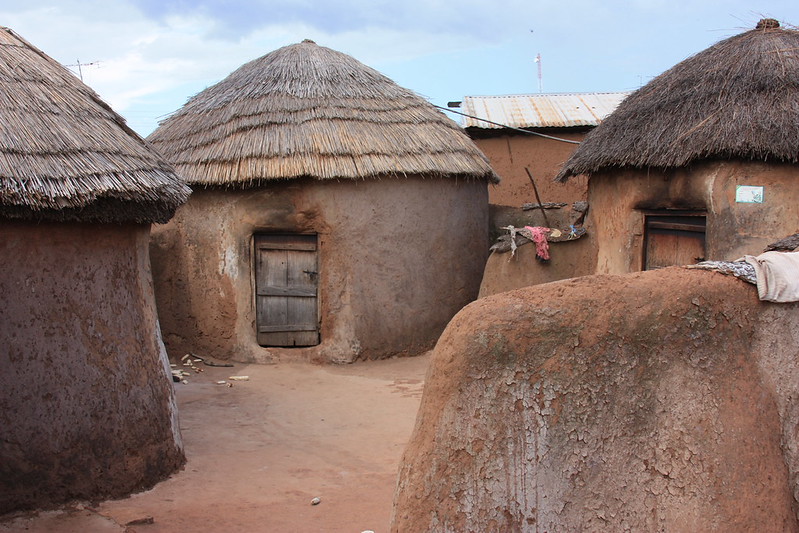
Many women have lived within the camps for decades, where they are exploited for free labour, sleep on dirt floors within mud huts in dire need of repair, without reliable access to basic sanitation, clean water, healthcare or food. The witch camps are referred to as safe havens by authorities, but prison is a more accurate description, and this prison’s walls are built with stronger material than brick or barbed wire: with the government failing to provide access to adequate food, safe housing, clean water or livelihood opportunities, the women have no way of leaving.
Lariba, who has lived in the Gambaga camp since 1999, has even tried to return home three times, only to be forced out by discrimination. The authorities and community leaders who run the camps have even been known to intercept the already-lacking provisions sent by humanitarian aid, which the witch camp’s prisoners need to survive. Sexual abuse has also been recorded within the camps, for example, when a priest fathered children with multiple women being held.
“I fast until someone shares food. Nobody takes care of us—not even the government.” Zina, a 70-year-old in Kukuo camp who survives on scraps.
The brand of witch and the assumption of guilt in causing the connected tragedy strip the accused of their dignity, family, and human rights. The associated stigma even spreads to the women’s children, who are often bullied and harassed as “witches’ children”. Having to wear this branding, and even being led to believe it, for many is the harshest part of the camp, as it is accompanied by deep-seated shame and guilt.
“The pain of being accused of killing my own son was unbearable.” Lariba, who contemplated suicide.
But how will the Anti-Witchcraft Bill change this?
If this bill is passed and signed into law, not only will the act of naming or accusing someone as a witch be outlawed, but also the spiritual consultations that offer trigger accusations, and encourage police and social workers to intervene in or prosecute witch-related abuses. The bill will also be the first step in developing reintegration programs to support survivors in regaining their independence, identity, and rejoining their communities.
However, the belief in witchcraft is entrenched in several communities, and much more work will need to be implemented by NGOs and at the local government to combat the stereotypes linked to witchcraft accusations.
“The accusation is the beginning of everything. If we stop it at the source, we can start to address the issue over time. We are not going to relent. We are going to keep pushing until this bill becomes law.” Professor Azumah, executive director of The Sanneh Institute, which supports survivors
The Bill has already come far too late for thousands of women, as these camps have run for over a century, and many have spent the majority of their lives confined within the camp’s imaginary walls. Still, it’s a chance to start tackling the roots of the witchcraft accusations, which are continually depriving so many women, particularly older women, of their lives and subjecting them to extreme suffering, discrimination and violence.
Amnesty International is currently campaigning to bring the Anti-Witchcraft Bill into Ghanaian law and to support survivors of witchcraft-related violence and witch camps, including the creation of a petition urging President John Mahama to sign the Anti-Witchcraft Bill to help protect these vulnerable individuals.