
In the 1700s, the streets of Aberdeen were not the place we walk today. The crown of King’s College still stood prowling over old Aberdeen, and the Castlegate towered over Union Street. Nowadays, we watch out for the youths that run rampant outside the McDonalds on Union street, but back then, you were concerned about a far greater threat. In those times, you weren’t anxious about being catcalled or mugged, but for being shipped off into slavery.
If you have walked past the Powis Gates onlooking the Kings Building, or ventured down to the basement of the library, you would have set eyes on the University’s link to slavery. Displayed on the Powis Gates is a placard that explains that those gates were built from compensation the family received for losing their slaves. The portrait of Dr Gilbert Ramsay, smirking at the other portraits in the Library Collections, tells of a graduate of Marshall College, whose slave empire stretched to the Caribbean. His fortune let him leave one of the largest legacies to the university, ever.
A young lad, born in Aboyne, innocently played by the Quay. What approached the boy was, what was called then, a spirit. Not holy, nor majestic, a spirit was the job description of a person who would kidnap children on behalf of the merchants. These merchants often would collude with the ballies (civic officers), who would hide their wrongdoings. Wee Peter was 8 at the time of his capture. The young lad, with merely the clothes on his back, would be held captive in the old Barnhouse by the green, the gable ends of which are still visible to this day. A piper would be stationed outside the barnhouse, the shrieking of the pipes being used to drown out the helpless cries of the stolen child. Then, by order of Uncle Sam, Peter would set sail for the Americas.
Peter would arrive on the North American coast in late 1743. Upon approaching the coast of Delaware, the ship would be knocked by a hard gale and hit a sandbank. While the ship filled with water, the crew decided to save themselves and scarpered from the scene. Left behind them were the loud wails of their cargo destined to perish. The morning after the crash, the captain decided to try to save what they could. Not because they felt the need to save innocent children’s lives, but a desire to not lose all their assets. Peter was one of the few that came out unscathed. However, he chillingly stated, “in my distress and miseries since, have I wished that such (dying) would have been the consequence.”
Peter spoke fondly of the man who was his slavemaster. A fellow Scotsman, his master would permit him to learn to read and write once he turned 14. Peter even offered to extend his servitude if he could attend school, which his master agreed to. When he died, he left Peter £200, a large sum of money in those days. Taken by his new riches, 17 year old Peter set off to explore the country.
For 7 years, Peter worked wherever he could, travelling from place to place. Peter would marry the daughter of a prominent plantation owner, and settle in a large farm house in the province of Pennsylvania. However, the steady improvements to his life that had occurred since he survived the vessel crash would end here. For not long after he settled into his new life, the French-Indians would besiege their property. While his wife was away, he would encounter the war-whoops of the attackers. A frivolous attempt to meet their violence head-on, Peter would be disarmed of his rifle, tied to a tree, and made to endure the burning of his home. He had no option but to bow to the wishes of his new masters. His wife would never see him again.
After witnessing countless murders and scalpings by the Indians over the next few months, he would escape thanks to the negligence of his captors. Upon his escape, he would make way for his father-in-laws. Reaching his plantation, he learned of the passing of his wife. The news would spread of his release and before long he would be made to give testimony to the State Assembly about his captors. The thought of revenge encouraged him to enlist in the army to fight the natives.
A successful soldier, he would rise to become a lieutenant of his regiment. But he wasn’t successful enough. In an instance of deja vú, the French-Indians captured him again. This time his imprisonment would not be nearly as prolonged. He would be soon traded by the Indians in a prisoner exchange, and sent on a vessel headed for Plymouth, England.
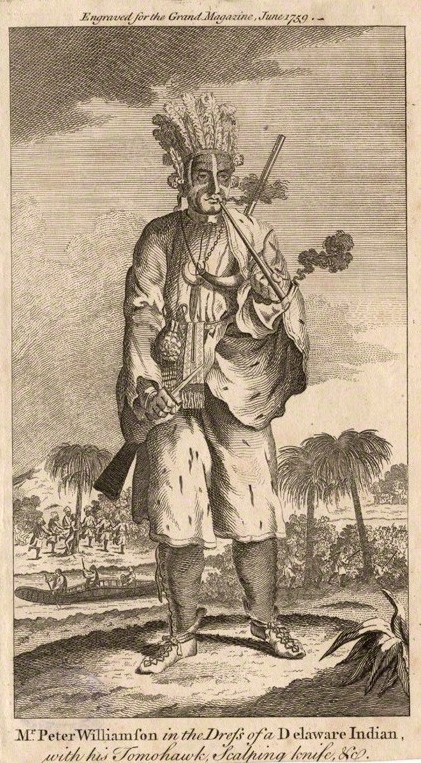
Peter made it his mission to return to the Granite City, an exact 1000km hike. Passing through towns of the English countryside, he would write a book of his adventures to earn him some money. He would dress as the Indians, cause commotion, and advertise his story. He was called Indian Peter and his story spread far and wide. But he wasn’t finished…
He finally returned to Aberdeen, 15 years after his kidnapping. In an effort to stop his tale from tarnishing the name of the local authorities, the city would burn all copies of his story on the Mercat Cross. The court, run by the magistrates that permitted his kidnapping, found him liable for defamation. He was made to denounce his claims and was banished from the city.
Peter would inevitably have the last laugh. He moved to Edinburgh and opened a coffee shop that was a fond place for local lawyers. They grew sympathetic with Peter’s story, and he was encouraged to sue the magistrates. Of course, he won. He finally got the justice he pursued.
The story of Indian Peter is nothing short of remarkable. His constant desire to remake the life he was forced to live will always sit deep within the hearts of those from Aberdeen. But it serves as an important reminder that our supposed innocence is built on a troubled past.