

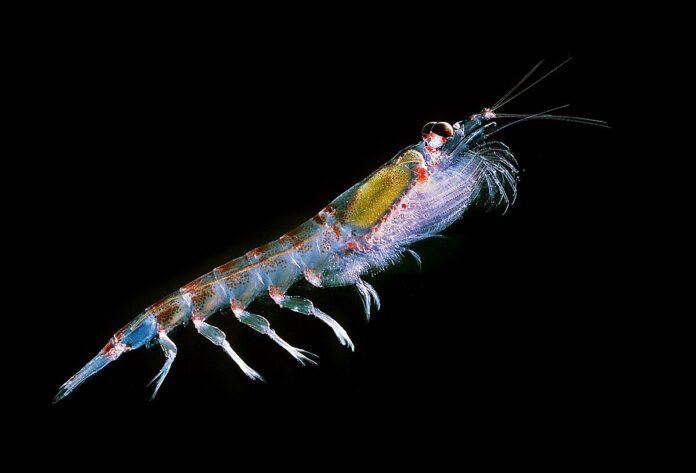
Antarctic krill are an essential part of marine life and support a plethora of species. Despite their importance, the role of these tiny heroes is often overlooked; it’s only now that people are realising that the loss of this species could have catastrophic effects on ocean life. Due to this, scientists from the WWF, the University of Strathclyde and the British Antarctic Survey (BAS) have joined together to monitor this species from space.
Antarctic krill are one of the most important species on the planet and play a vital role in the food chain. Many ocean creatures depend on these tiny organisms for survival, including some of the sea’s most iconic characters, such as the humpback whale. Krill are not only the foundation of marine life; they are also climate warriors and play a significant part in drawing carbon down from the ocean’s surface. Despite their tiny size, Antarctic krill draw approximately 0.3 million tonnes of carbon into the ocean a day, which is equivalent to the UK’s daily CO2 emissions.
You’ve heard it many times before, and you’ll hear it again: climate change is one of the main factors putting this incredible species at risk. The global increase in temperature is causing sea ice to melt. Sea ice is an essential part of krill nurseries, which means that melting sea ice will reduce birth and population growth rates for krill populations. Unsustainable fishing has also disrupted krill populations, and if krill are overfished, marine species such as penguins, seals and whales will also suffer due to reduced access to food. On top of this, mercury pollution negatively affects krill and marine life. High levels of mercury have been found in Antarctic krill, and once mercury enters the food chain, any animals that are part of this food chain are poisoned; this includes any humans that eat contaminated fish. Since krill are the most important part of many ocean food chains, this is a significant problem.
First launched in November 2020, the Krill from Space Project aims to monitor the distribution and population of krill by analysing and comparing light patterns in the ocean. These light patterns, combined with satellite and sensing data, will help scientists better understand krill populations. This can help conservation scientists determine which areas of the ocean need the most protection and come up with more effective ways to manage industrial fisheries.
Ocean colour satellites have been used since 1997, but their importance for ocean conservation projects has only been identified recently. Scientists have successfully identified a signal that makes krill appear red in satellite images. This allows them to easily identify and count krill populations and clearly understand what kind of ecosystems krill thrive in and where they need more support.
The Krill from Space Project is a big leap forward for krill conservation and protection. Identifying problem areas allows projects to be more focused, which makes them more likely to be successful in the long term. But has this project been launched too late? Krill populations have declined by 50-80% of their original numbers in the past few decades, and if these numbers can’t be restored, their loss will have a devastating impact on all ocean life.
