

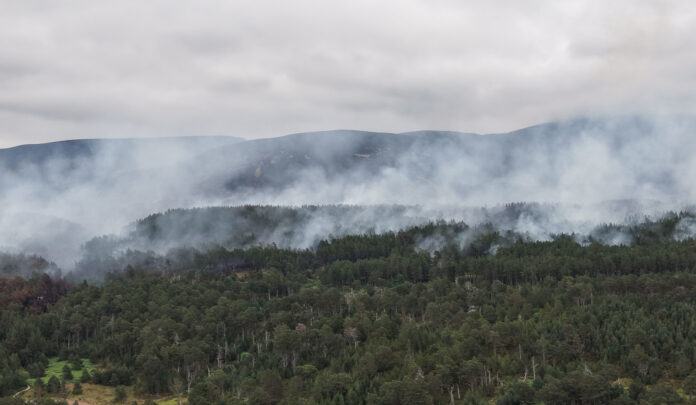
“Positive progress” in fighting the Cairngorms wildfire has allowed residents to return to their homes after a three-week blaze.
Residents of Nethy Bridge have been encouraged to return to their homes after being forced to evacuate over a week ago. This comes as emergency services continue their multi-agency response to control the fire that was declared a “major incident” in July.
The fire was first reported at 11.49am on the 15th of July near Glenmore. Two days later, the Scottish Fire and Rescue Service confirmed a multi-agency response was underway including waterbombing helicopters and over fifty firefighters.
As the fire continued into its second week, Police Scotland declared the fire a major incident. The flames travelled in the direction of Nethy Bridge and the residents were advised to evacuate to Aviemore as a precaution.
Scottish First Minister John Swinney chaired a Scottish Government Resilience Room (SGORR) meeting on the same day. In a statement the following evening, Swinney announced “all resources that can be deployed are being deployed.”
By the next day, a fire break had been completed to protect Nethy Bridge, and a change in wind direction allowed residents to begin returning from the 25th. After the second SGORR meeting, First Minister Swinney confirmed that “the strongest and highest level of fire and rescue resources” will remain available until the fire is fully extinguished.
The Scottish Government also stated that they had requested military assistance from the UK Ministry of Defence while exploring all avenues for support. However, the MoD replied that their only firefighting resources are not stationed in the UK. The Royal Air Force has two Chinook helicopters based in Cyprus which support firefighting as part of the island’s broader military presence.
On the 29th of July, the Cairngorms National Park announced “positive progress” had been made in tackling the fire, but that hotspots would take additional time to cool. The update also confirmed that Police Scotland, Scottish Fire and Rescue Service, Forestry and Land Scotland, RSPB Scotland, and volunteers were involved in controlling the wildfire and clearing debris.
2025’s four-day fire near Grantown-on-Spey was described in a report by Stanford University as Scotland’s first “megafire” last May. The ongoing fire in the Cairngorms is just the latest fire in this trend with smoke being reported from the fire on oil rigs off the coast of Norway.
Further wildfires are also raging in areas of England and Wales. One fire in Suffolk was declared a major incident last week. The Telegraph has reported the UK Government is considering pulling the military helicopters in Cyprus back to the UK to support firefighting efforts.
Spain, Greece, and France have all also been victim to large scale wildfires over the last couple of weeks. France has been forced to deploy their largest evacuation since World War Two.
Last year saw Scotland suffer from the highest number of annual wildfires since record began. As a result of this, the Scottish Government launched its Wildfire Strategic Action Plan in March 2026 to improve prevention, preparedness, and response to wildfires.
