

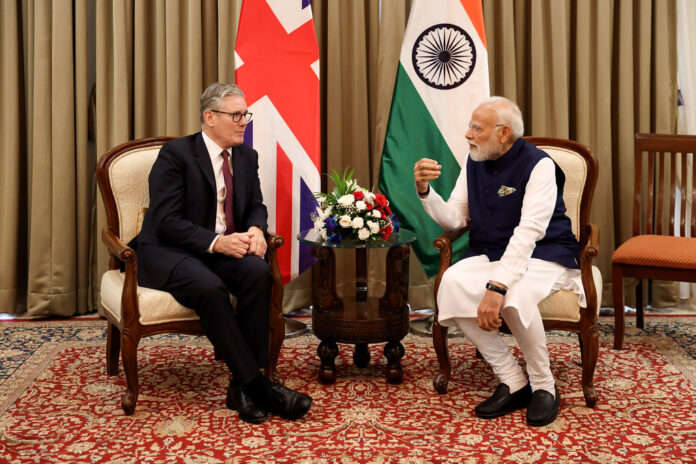
UK Prime Minister Keir Starmer has visited India, leading a trade delegation of 126 entrepreneurs, businesspeople and university heads from the UK. Touching down, Starmer was welcomed by India Prime Minister Shri Narenda Modi on the eighth of October for his two-day visit.
Upon leaving India, Starmer posted on social media that he had created “10,000 jobs and got £1.3B worth of investment back into the United Kingdom.”
The PM’s visit came only months after the establishment of the UK-India Strategic Partnership in June, where both leaders pledged to double the current UK-India trade value of fifty-six billion US dollars by 2030. UK industries are now being encouraged to manufacture in India, and 99% of trade between the two countries is now tariff-free. The October visit saw much further discussion on UK-India cooperation, including the aerospace, artificial intelligence, health technology, green energy, and education sectors.
A much more volatile world also saw an emphasis on defence, with India to integrate its pilots into the UK’s training programmes and British industry to develop propulsion systems for Indian warships. Both leaders condemned the terrorist attack which killed twenty-six in the contested region of Kashmir last May. India accused its neighbour Pakistan, who also contests Kashmir, for sponsoring the attack, launching military strikes which sparked a brief conflict between the two nuclear powers.
However, despite both Starmer and Modi expressing support for upholding the international law as defined by the United Nations, they still disagree on fundamental global issues. India is a member of the BRICS economic bloc, which is designed to support developing countries in the western-led international system, but also includes Russia and China. India still relies on Russian oil and gas, also importing military equipment from Russia, and refuses to condemn the full-scale invasion of Ukraine.
Starmer’s visit also coincided with a major military exercise off India’s coast. Although exercises between the UK and India take place regularly, this iteration saw it centred around the aircraft carriers HMS Prince of Wales and INS Vikrant, with their ten escorting and supporting warships.
The Indian Navy commented on X that both navies “maintained high operational tempo during advanced tactical air warfare and air defence drills involving carrier-based fighter aircraft.” Royal Navy commanders also visited INS Vikrant, which experienced its first real mission during the aforementioned India-Pakistan clashes earlier this year.
Shortly after the exercise, British warships visited Mumbai and Goa on India’s west coast to let the sailors rest and host engagement with the UK and Indian defence industry. Indian warships have visited the UK as recently as 2021 and 2023 although usually done as part of a voyage to or from the Russian port of Saint Petersburg, where some Indian warships are built.
Closer ties between the UK and India do not just mean an increase in cooperation between two states, they also help loosen the UK’s dependence on importing Chinese-manufactured goods. This would allow the two nations to more freely challenge China’s territorial claims across the Asia-Pacific, as less reliance on trade with China would reduce the economic consequences Beijing could impose.
