

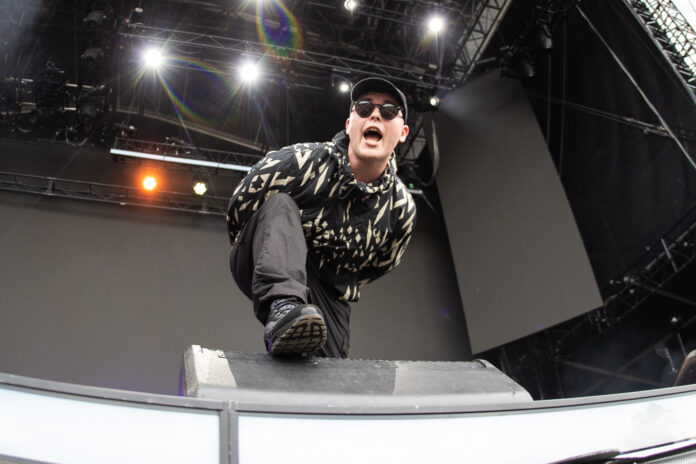
As the Labour government cracks down on protest activates, the trial of Liam Óg Ó hAnnaidh better known by his stage name Mo Chara is to many a glaring testament of the government’s inaction over the genocide in Gaza.
The rapper for the group Kneecap was charged in May under the terrorism act for allegedly waving a Hezbollah flag on stage last November. The rapper was accused of supporting the prescribed organisation. Mo Chara was acquitted of the charge in late September of this year due to an error in how he was charged. The judge who dismissed the case called it “unlawful.”
The trial acted for many as a microcosm of much wider issues; the UK governments complicity in the genocide in Gaza and the historical use of terrorism charges by the British government against people in Northern Ireland.
On the 16th of September the UN commission of inquiries board ruled that Israel has committed a genocide on the Palestinian people in Gaza. This ruling comes after nearly two years of Israeli bombardment, forced displacement and systematic starvation of the civilian population in Gaza that is now reaching the West bank. Despite the UN’s ruling the Labour government has not yet “concluded” that Israel is committing a genocide according to a statement released by the current deputy prime minister David Lammy. Moreover, according to Oxfam as of August 2025 the UK government continues to sell arms to Israel despite growing public calls not to. In the same month it was reported that the UK government still performs nearly daily surveillance flights over Gaza city.
Many have speculated then that the Kneecap trial as well as the proscription of Palestine action were done in an attempt to distract from the government’s complicity or even to ignore and suppress growing calls for accountability.
The deeply historical context of the band cannot be ignored either. One member of the group adorns a Tricolour balaclava, and his stage name is DJ Próvaí, the Gaelic term referring to the provisional Irish republican Army (Provo). The group are strong advocates for Irish unity and independence as well as the promotion of Gaelic. The group and their relationship to the British government can therefore not be separated from its history.
From 1971 the British government introduced internment across Northern Ireland. Operation Demetrius allowed people to be imprisoned without trial and often a specified sentence. This caused mass arrest across the North of people suspected of being involved in IRA activity. Until it ended in 1975 it is estimated that almost 2,000 people were interned, the majority from catholic communities. In 1980 a group of republic prisoners began a hunger strike (another started a year later). The hope of the hunger strikers was to be recognised as political prisoners. This status would’ve granted them privileges such as wearing normal clothes and more visitations. During the 1981 hunger strike ten men died for this status. When Bobby Sands MP died on hunger strike Margaret Thatcher called him a “criminal” and did not grant political status to the other hunger strikers.
The kneecap trial as well as previous comments made by the British government regarding the group reminds many of the mass convictions against nationalist people in the North. Many fear that the 2008 terrorism act allows the UK Government to overstep and accuse people of terrorism excessively.
