

By Georgie Burns
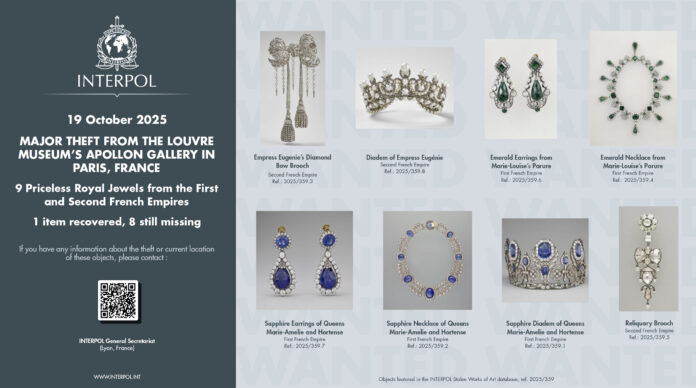
On the morning of October 19th, the art world watched in horror as four professional thieves, disguised as construction workers, executed a meticulous robbery that would leave France reeling. Armed with power tools, the team ascended to the balcony of the Apollo Gallery at the Louvre using a vehicle-mounted mechanical lift, cut through the window, and used a display of force so that guards had to evacuate. In less than eight minutes, they had smashed their way to eight invaluable pieces of French history before escaping on mopeds into the bustling streets of Paris. The entire heist was flawless up until the Empress Eugénie’s crown was dropped during the escape, damaging a priceless artefact that contains 212 pearls and nearly 2,000 diamonds.
Even without the crown, the thieves’ prize is priceless. Not only are the pieces all comprised of precious metals and, according to jewellery historian Carol Woolton, some of ‘the most important gemstones from the Louvre’s collection’, with ‘beautiful large flawless stones’, but they also all once belonged to Napoleonic-era French royalty or imperial rulers, making them invaluable relics of the nation’s heritage. However, the fate of these treasures is bleak, with experts fearing that the art is already destroyed. When paintings are taken they often resurface, intact, years or even decades later as all the value is in the artistry. However, jewellery and sculpture are often targeted for a different reason: the raw materials. Within 48 hours experts believe the pieces would have been melted down, with gems recut, and sold for a fraction of their worth – rendering them irretrievably lost to history.
Although most of the public was shocked by the Louvre robbery, experts have explained that it was not an isolated incident, but part of a disturbing increase in museum thefts worldwide. From the conflict-driven looting of artefacts in Gaza to the notorious inside job at the British Museum, where over 2,000 items were sold right under the institution’s nose, the pattern is clear: museums are under attack and governments are not protecting them. Even at the Aberdeen Art Gallery and Museums’ collections, over four years after more than 1,300 items were declared missing, a significant portion of the artefacts remain lost, with at least 120 items now being classified as stolen. Recent years have also witnessed a surge in robberies, like the Louvre heist, which target precious metal artefacts for their material rather than their cultural value. For example, Bronze Age gold artefacts were taken from St Fagans museum in Cardiff less than two weeks before the jewellery was stolen from the Apollo Gallery. This spike followed a previous outbreak of jewellery shop thefts that led to most outlets improving their security. Museums, with their public-facing status and lack of funding, therefore became the lower risk target.
‘Artworks worth over $6 billion are stolen annually – only 10% are ever recovered,’ reads a statement from Interpol.
Having worked in museums since I was 16, I’ve seen firsthand the profound impact interacting with tangible elements of history can have. Their theft erodes shared history, identity, and pride, and represents an irreplaceable loss. Crown jewels, however, are often seen as symbols of society’s elite and therefore may seem exempt, especially in France, where the aristocracy is not remembered fondly. Social media even lit up with amusement at the Hollywood-esque escapades when news of the heist first broke, an injury-free robbery being a minor headline in today’s world. In the movies stolen art often goes on to a glamorous afterlife, whereas these pieces are likely destined for destruction, a realisation which then led to outrage. Many in France have emotional connections to the art and the fragments of their cultural heritage they represent; their loss has ignited discussions about security, politics, and even if this marks France’s decline.
‘It’s as if someone had stolen the Mona Lisa from us… Someone stole France,’ stated Alexandre Leger, head of heritage at Maison Vever.
While the hunt for the Louvre robbers continues, discussions about new security protocols and systems for public institutions globally are taking place. Hopefully, this will result in radical reformation and change the troubling position that cultural heritage has been reduced to, where France’s most famous museum is a softer target than the local jewellery store.
‘What is certain is that we have failed,’ stated the justice minister, Gérald Darmanin, while describing how the heist gives ‘France a terrible image’.
The intrigue and audacity of a broad daylight heist will undoubtedly mark October 19th in our history books. While the cinematic elements of the heist may capture our imaginations, it represents an assault on French and global heritage. The Louvre is the latest victim in a series of crimes targeting our collective history, and we need to demand the protection of our cultural treasures as their homes come under siege.
