

by Megan Shand.
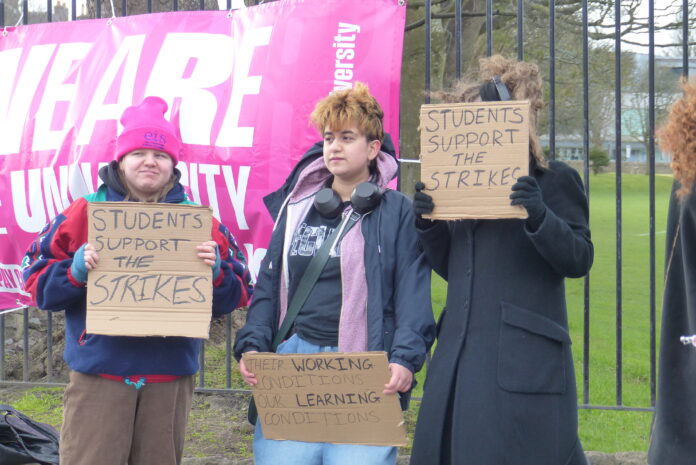
Recent plans from the University of Aberdeen (UoA) to cut costs have prompted some students to draft an open letter, voicing their disapproval of proposed changes and supporting staff who went on strike.
UoA’s Archaeology Society and the Aberdeen Socialist Worker Student Society worked together to write the letter in the hopes that a strong display of student opinion will encourage the University to reconsider their plans.
Amongst other things, the University has proposed restructuring that would see the current twelve school system condensed into a four faculty structure, a centralising of administration teams, and a minimum number of students per staff member in courses and programmes.
This comes alongside the University’s recent voluntary severance and early retirement scheme that has already been a contributing factor to at least 23 people leaving their jobs in Student Support Services across the last three years and over 440 staff leaving the university over two years.
In an interview with The Gaudie, petition author Charlotte Doig from the Archaeology Society, said that the main goals of the open letter were to get the university “to engage meaningfully with staff and students on these Adapting for Continued Success plans” and to “force them to commit to no mandatory redundancies”.
The threat of redundancies sparked recent strikes as many staff feel uncertain about their job security. Charlotte said, “I think it’s important for staff to know that they have students’ support on this”.
The University’s Principal and Vice Chancellor, Professor Peter Edwards, told BBC Scotland in December that he hoped redundancies could be avoided but, with the university aiming for £12 million in savings by 2027-2028, he has never officially ruled them out.
The letter also speaks out against restructuring plans, which Charlotte fears would harm the student experience, with Student Support Services potentially becoming harder to navigate and class sizes being larger.
The student said, “I think the community aspect is something that you would really lose, which is a key part of student satisfaction.”
An anonymous supporter of the letter said “smaller class sizes in languages have always been beneficial,” highlighting that arts, humanities, and languages courses would be most affected by the plans for a minimum number of students in staff to student class ratios, with there being 25 students required per staff member in these courses, while STEM classes can get away with a 20 students per staff member minimum.
Students who have signed their names to the letter have also anonymously expressed opposition to the plans in general and urged the University to further consider the experiences of students and staff, saying, “Student satisfaction is dependent on teacher satisfaction. The university is a place of learning, not a business.”
When Charlotte spoke with The Gaudie last week, the letter had garnered 111 names and was hoping to gain more before presenting it to the University Court and senior management. The letter can be found on the social media pages of the archaeology and socialist worker student societies, as well as other affiliated societies.
She also said that students can get further involved in protest by joining staff at the picket lines in the future, by researching the Adapting for Continued Success plans, and by emailing their thoughts to the senior management team.
