

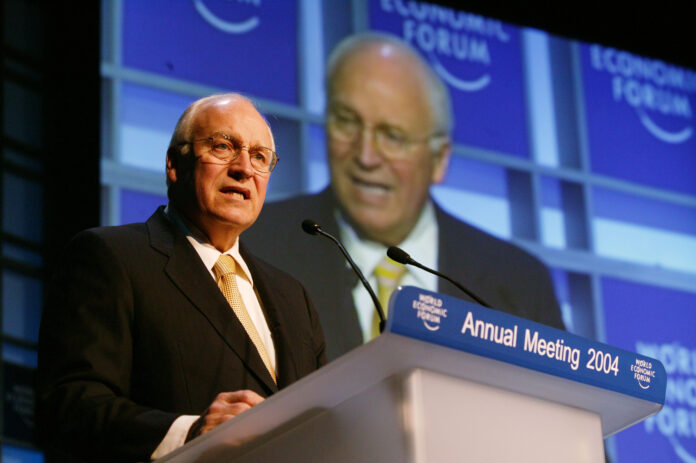
Former vice president Dick Cheney died the night of Monday 3rd November due to complications of cardiac and vascular disease, as per a statement from his family.
Cheney had previously suffered from heart attacks, dating back to his first congressional campaign in 1978. His long history of health problems led to the following four heart attacks, several surgical procedures and eventually a heart transplant in 2012.
His tenure in politics defined by terrorism, war and unprecedented use of power, Cheney was known as a “giant” in Republican politics.
Cheney was born in 1941 in Nebraska, but grew up in Wyoming, where he would eventually serve as a six-term member of the U.S. House of Representatives. Inspired by the likes of Donald Rumsfeld, who recruited him to be a staffer in 1968, and would later work with him in the Bush White House in 2001, Cheney would lead a fruitful political career.
He accumulated a number of positions in his time under several administrations, but most significantly, serving as vice president from 2001 to 2009 under president George W. Bush.
Perhaps the penultimate moment in Cheney’s tenure; the moment that granted, on an international scale, the credibility for what the Bush administration would pursue, was the 9/11 terrorist attack.
On the 11th of September 2001, four planes were hijacked by al-Qaeda; two collided with the Twin Towers in New York, one hit the Pentagon and one crashed over Pennsylvania. Close to three thousand people died in the attacks.
Cheney had been vice president under George W. Bush for 7 months at the time of the attacks and was one of the only senior US officials in Washington that morning, due to Bush being in Florida. Cheney was taken to the Presidential Emergency Operation Center, where he would make the decision to shoot down the fourth plane should it enter Washington DC – an unprecedented situation, as the vice president is not included in the military chain of command, however Bush was unreachable.
The former vice president would later be the driving force in the US’s War on Terror. It wasn’t long until there were troops on the ground in Afghanistan, fighting Taliban and al-Qaida forces, but the invasion of Iraq is the stain on Cheney’s reputation that dominates.
One of the ways Cheney was able to convince the American public of the invasion into Iraq, was a notorious Meet The Press appearance. Prior to this appearance, Cheney had his Chief of Staff Lewis “Scooter” Libby leak false information to New York Times journalist Judith Miller – that information being that Saddam Hussein had weapons of mass destruction (WMDs). When asked what evidence Cheney had of Hussein’s WMDs, he quoted the New York Times:
“Simply stated, there is no doubt that Saddam Hussein has weapons of mass destruction.” were the words said on Meet The Press.
By March 2003, when US and allies had invaded, no evidence had been found for any of Cheney’s claims. No proof has been found to this day.
“Cheney was a key figure in corrupting the intelligence-policy relationship on behalf of selling the Iraq war,” said Paul Pillar, who was a national intelligence officer in the National Intelligence Council at the time of the invasion.
As for the aftermath of the War on Terror, the death toll was unimaginable. According to the Costs of War project, an estimated 940,000 people were killed by direct violence in Iraq, Afghanistan, Syria, Yemen, and Pakistan. This figure does not include those displaced, those killed by indirect violence or military personnel.
Above all, Cheney remained unapologetic for his record.
Alongside the Bush administration’s War on Terror, came the USA Patriot Act. Just six weeks after the attack on the World Trade Centre, the Patriot Act’s passage was forced through Congress. The Act, of which Cheney played a critical role in, saw a vast expansion of the powers of the executive to carry out investigations and warrant-free surveillance under the stated purpose of counter-terrorism.
Cheney’s undermining of the independence of intelligence agencies and US adherence to international law, perhaps paved the way for the Trumpism that infects America today, despite appearing to moderate in his latter years, and warning of the dangers of Donald Trump.
In perhaps an act of conservative grievance, Cheney considered the powers of the presidency, arguing that the White House had been unfairly constrained by Congress in the aftermath of the Nixon administration’s Watergate scandal. The groundwork for such an authoritarian presidency was laid by his legal counsel, David Addington. The unitary executive theory would provide the rationale for the Bush administration’s objectives, and has since been utilised by the current US president Donald Trump.
Cheney was a firm believer in expanding the powers and abilities of the White House, leading the way to sell the Iraq war. In his view, the American president should have a free hand in wielding US power in the world. He is considered by many respects responsible for the direction the Republican party took.
The unitary executive theory has empowered Donald Trump in his second term, with the weakening of Congress’ role in constraining its recent military actions off the Venezuelan coasts, the justification of suppression of dissent, and even the use of force within US agencies by the dramatically amplified Immigration and Customs Enforcement.
“Every subsequent president, via the drone or extraordinary surveillance programmes, has built on Cheney’s legacy to get to the present moment in US history.” said Alka Pradhan, defence lawyer and law professor at the University of Pennsylvania.
Cheney is survived by his wife, Lynne Cheney and daughters Liz and Mary.
