

Artificial Intelligence (AI) has been at the forefront of technological debate since its invention. However, while the dangers and pitfalls of AI and the way it can be used in daily tasks have had international coverage, its role in tackling cardinal issues within the world of medicine, particularly antibiotic resistance, remains largely overlooked by the general public. Last month, scientists at the Arc Institute based in California demonstrated the advantageous nature of AI in medical research by creating new bacteriophage genomes to contribute to the battle against antibiotic resistance via the use of these microscopic entities against bacterial infections.
The Plague of Antibiotic Resistance
First, to provide further context for this groundbreaking research, it is important to have a fundamental understanding of antibiotic resistance and why it is such an extensive problem. Antibiotic resistance is a phenomenon in which bacteria lose susceptibility to antibiotics designed to destroy them. This is attributable to rapid bacterial evolution as a consequence of their elevated division rates and proclivity to horizontal gene transfer, a process through which bacterial cells can exchange genetic information between themselves, allowing them to acquire new functions that prolong their survival. In particular, bacterial cells are notorious for exchanging antibiotic resistance genes, making them unresponsive to traditional antibiotic treatment on a cellular and genomic level. In layman’s terms? Bacteria are becoming faster and stronger, and our antibiotics can’t keep up. Not only this, but the more antibiotics are used, the quicker the bacteria evolve, creating a vicious cycle.
The most well-known strain of antibiotic-resistant bacteria is MRSA, which stands for methicillin-resistant Staphylococcus aureus. Known as a superbug, MRSA is resistant to a range of antibiotics and can result in subsequent mortality, making infections by this strain gravely serious.
MRSA is not the only culprit, and antibiotic resistance has been observed in other common bacteria such as E. coli. Antibiotic resistance is part of a wider issue of antimicrobial resistance, which includes resistance against antifungals, antivirals, and antiparasitic agents. According to a study cited by the World Health Organization (WHO), antimicrobial resistance was the root cause of over a million deaths and played a part in nearly five million deaths around the world in 2019, making it a sweeping public concern.
Humans have fuelled the fire that has resulted in antibiotic resistance becoming a pandemic. The widespread use of antibiotics in both developed and developing countries has created the ideal conditions for antibiotic resistance to advance, as selective pressures are placed upon bacteria. In simple terms, the bacteria that are capable of surviving and thriving in conditions where antibiotics are present will be able to reproduce and pass down their antibiotic resistance, ultimately making them difficult to eradicate.
Role of Bacteriophages
However, the solution to the problem that we have created also lies in our hands. Surprisingly, it may also lie in the hands, or more precisely, in the genomes of viruses called bacteriophages.
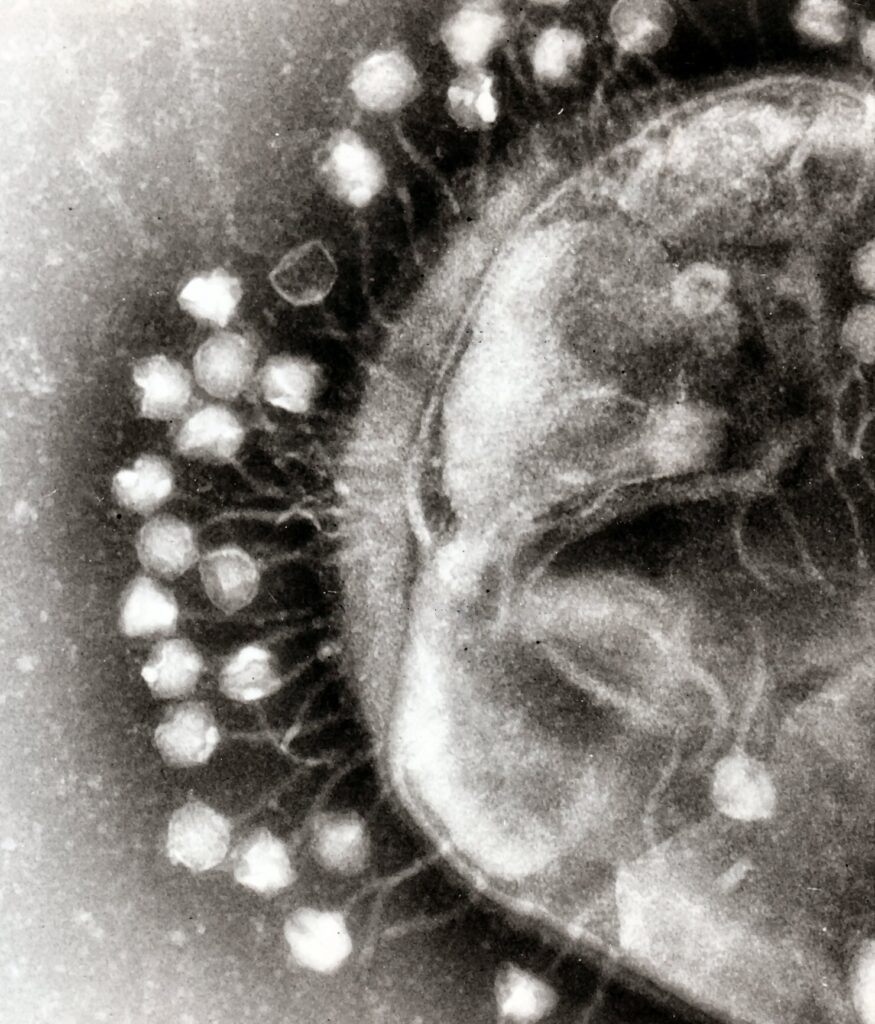
Bacteriophages, also known as phages, are natural viruses that infect bacteria. They were discovered in the early 20th century by Frederick Twort and Felix d’Hérelle and are considered to be the most widespread biological entity on Earth, with an approximate prevalence of one trillion per grain of sand worldwide. These viruses not only have the capacity to be species-specific but can also exhibit strain-specificity. Through injecting their genome (aka all their genetic information) into a bacterial cell, bacteriophages can hijack the cell’s molecular machinery to propagate themselves, ultimately resulting in the death of the infected bacterium.
Since bacteriophages can infect bacteria, they represent a powerful tool against antibiotic resistance. However, the use of bacteriophages against infection is not a new concept. The first bacteriophage therapy can be dated back to 1919, when d’Hérelle, prompted by his discovery, treated children suffering from bacillary dysentery using viruses specific to Shigella, the bacterial species responsible for the disease. Following this, in the 1930s, pharmaceutical giants such as Eli-Lilly & Co. started manufacturing bacteriophage therapies. Despite the gradual loss of popularity as a result of growing accessibility to broad-spectrum antibiotics and increased debate within the scientific community, chronic staphylococcal infections were still remedied by bacteriophages in the United States until the late 80s. And now, the technique could be making a comeback, with a 21st-century twist.
The First AI-Generated Viruses
Although bacteriophages are natural entities, recently, a team of scientists at the Arc Institute devised completely new bacteriophages that have never been seen before in nature. Led by Brian Hie and Samuel King of Stanford University, the team used the AI models Evo 1 and Evo 2 to carry out their project, alongside the single-stranded ΦX174 bacteriophage genome as a framework, which, historically, was the first genome to be sequenced and constructed synthetically by humans.
Previously, Evo 1 and Evo 2 models have been used to study and create DNA sequences, but they have never been used for producing an entire genome…until now. Evo 1 was initially developed by the Arc Institute in partnership with Together AI, and Evo 2 was released thereafter as a joint effort with NVIDIA, a world leader in technological advancement. While Evo 1 was designed using only the genomes of single-celled organisms, Evo 2 is built not only on genomic information derived from unicellular organisms but also from those that are multicellular, such as plants and humans. This feature makes Evo 2 currently the most comprehensive biological AI system ever to be created.
Upon reviewing thousands of DNA sequences generated by the models, Arc Institute scientists selected and artificially synthesised around 300 bacteriophage genomes. These genomes were then ‘brought to life’ in a host organism, a process that involves introducing the synthetic DNA into a living cell where it can be transcribed and translated into functional proteins. Of these, only 16 were able to infect E. coli and destroy different strains. These viruses do not have the potential to infect humans and subsequently represent a prospective solution to our urgent need for antibiotic alternatives. According to Peter Koo, a computational biologist based at the Cold Spring Harbour Laboratory in New York, the Evo1 and Evo2 models are unable to produce viruses independently at present, but this research conducted by the Arc Institute “provides a compelling case study of what is possible today and sets the stage for more ambitious applications in the future”.
It is undeniable that Evo 1 and Evo 2 represent a stepping stone to artificial life. While research investigating the use of AI-generated viruses against disease remains in its infancy, it’s important to note that there may be potential risks or limitations associated with these viruses. However, while we must be cautious, artificial intelligence and bacteriophage therapy could represent the key to conquering the antibiotic resistance pandemic and save millions of lives.