

Like many 20 somethings, I unfortunately use Hinge. I have trawled through my camera roll to select the 6 best photos of myself, picked the least cringy prompts available, and written silly answers for each of them to replicate some shred of my personality in order for similarly aged singles near me to maybe laugh at one, think I’m pretty, and send me a like. Then, we’ll match and embark upon a wondrous journey of small talk, social niceties, and if I’m lucky, move to a secondary platform for continued chat (hello Instagram). And sometimes, if I’m feeling particularly kind, I’ll even meet a select few of my matches, before the cycle continues over again.
I suppose this is what modern dating has been reduced to nowadays, so I can’t really complain. I put myself on the app, so the interactions that come from it are truly the consequences of my own actions. But why am I writing about it now?
My decision to create this article came about in two ways.
Like many poor choices, this whole project began with a bad first date. I had matched with a man on Hinge, and we had carried some solid conversations for a month or so before finally finding a time to meet for coffee. The fun, interesting, and flirty flow of chat we had experienced over Hinge, and then Instagram DMs, came to a quick halt – truly nothing was happening conversationally on that date. To be harsh, it was like trying to bleed a stone. He talked, when asked, but no questions were reflected back onto me. As a journalist, the interaction started to feel familiar – the date was like an interview, a Q&A over coffee. As I complained to my friends in the pub that night, I joked about the idea of finding interviewees for projects using dating apps, then brushed off the idea. I had a summer ahead of dating, writing, and fun – I didn’t need to combine those aspects of my life. How wrong I was.
The second, and final push, that set me on this project came in the form of summertime disappointment. As the end of semester two neared, I had firmly decided that Summer 2025 was going to be my season. I was single, freshly into my twenties, and ready for a few months of almost bucket-list-like fun. I had a goal to revive my personal writing website, start consistently publishing my own projects, and hopefully draw on my upcoming lived experiences from the following months to fuel a new era of writing I could be proud of. I then got a full-time job that halted this plan. For me, my fate was sealed – if I was going to be able to socialise, date and write whilst working (and not burning myself out in the process) I would need to combine them all.
I set out to write a comment piece on Hinge and thought that the best way to gather insight into the hellscape of online dating in your twenties, would be to ask the culprits themselves. So, I remade my profile from a journalistic perspective. Once again, I selected my best 6 pictures, but altered my prompts to suggest I was looking for interviewees as a student writer. My account read things like “First rounds on me if: you wouldn’t mind being interviewed for an article about hinge and online dating?”, “The way to win me over is: agree to be my subject for a newspaper piece on Hinge” and “I want someone who: is willing to take a leap of faith and do something a little unique for a first date”. Having no idea what to expect, I was sceptical of whether my requests would gain any sort of attention. My account, for regular dating, had been relatively successful, and I wondered whether this would diminish after the possibility of ‘real’ dating was removed from my profile. But, always an optimist, I wrote my prompts, told myself “I’m Louis Theroux” and hit update.
Within 24 hours, I had three interview first dates confirmed, with a few backups prepared in advance. The people were, surprisingly, very intrigued. My dates stretched across the gender spectrum and also included those in open relationships – it was important to me that i covered all areas of the dating world. Many commented on the uniqueness of the situation, commenting that it sounded like the start of a rom-com. Determined, and slightly terrified, I set off with my interviews (whilst also continuing to date normally with my now reverted-to-normal Hinge account – for market research of course).
My first interview was with a man named Scott (which has been changed for anonymity. As a scholar, Scott asked that I selected the name of some great writer as his pseudonym, so meet Mr. Fitzgerald). I conducted the recruitment slightly differently, as we had actually matched normally, failed to chat, so I checked in a few weeks after our initial match to see if he had wanted to be involved in my piece. Luckily for me, he did and was free later that same day. We arranged to meet in a pub for a pint, and I told him I’d set out the framework of the interview once we were both chatting in person.
We both ordered a beer, sat down, and got into it. I began by asking Scott what he thought of the project I was conducting – why was he even here? Scott explained that it sounded unique, and as an academic, he was always going to be interested in a pursuit of knowledge. He agreed that the topic of Hinge, and online dating, was something that could generate a lot of material for an article and thought it would be fun to be involved.
We engaged in a heated discussion about the art of flirting and picking up in public. Scott explained that he will still try to approach those who he finds attractive in social settings, which I appreciated to hear. We discussed how much more sincere compliments are when are delivered with the courage of face-to-face interaction, and how usually those interactions, whether they lead to a date, a phone number, sorrow, or absolutely nothing, will always stick out in our memories far longer than a hastily typed compliment on Hinge. Scott explained that he felt the phenomena of talking to new people in public was far more prevalent in the USA, and seemed to be a lost art in the UK. I agreed, having found that small talk was a far more accepted part of culture across the pond. This took us on a tangent of social differences between the two countries that ended up derailing our interview slightly but was just as equally interesting. Perhaps my next piece will be inspired by that.
One of my favourite things that we discussed was the lack of clarity that exists for dating due to apps, and how this issue arises through the “what are you looking for” section on Hinge. I have always felt that this sets dating up for failure, as it immediately pre-plants an idea into potential match’s heads. As we established, long gone are the days of natural meet ups, where connections were explored for the sake of pure connections. Now, we have preplanned labels and goals, that dictate who we swipe upon and disregard us from potential matches. We spent time criticising those who use the app for nefarious purposes, and it felt like conversations I’d had before with my friends who had been ghosted or perved on via the app. As much as anything else to do with dating, Hinge is never free from creeps, or those who want to use others.
Overall, I felt the interview was very successful. Scott was a lovely guy, and I was deeply grateful for his time and effort.
However, whilst writing up this article, I started to realise that I myself had emulated a lot of the patterns that my fellow matches, potential dates, and peers had criticised so heavily of online dating. I viewed my matches as transactional, on a quest to serve my own chase for a juicy story. Maybe, the pitfalls of online dating are inevitable for those who attempt to navigate it? Without realising, and whilst also being hyperaware of the negativity that surrounds those who commodify dating, I had somehow slipped quietly into a hazy no-mans-land of Hinge-warrior behaviour. Whilst my transaction-searching nature on the app wasn’t based on sex as a trade-off, I was still using Hinge to satisfy my own needs. Whether journalistic or not, this realisation didn’t sit well with me, and I decided to call off my next “date”.
With one date completed, one cancelled by a candidate, and one cancelled by me, I thought it was time for a change in tactic, so I decided to turn to the largest group of peers I had access to – Instagram. I asked my followers a series of questions about hinge and online dating, and the results were fascinating. I’ve never gained more traction on a singular set of stories, and I was delighted with how much my followers had to say.
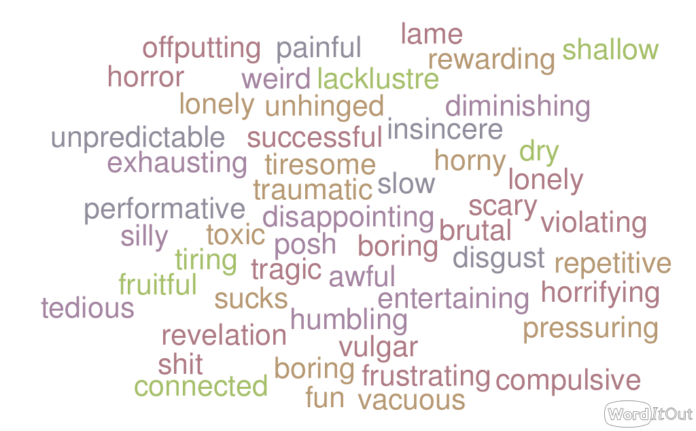
Overall, my peers agreed that Hinge was not exceedingly successful. Out of the hundreds that completed my polls, 63% said that, whether it had ended or not, they had not found what they were looking for during their time on Hinge. Despite this, 76% answered that they were still more likely to use Hinge than any other dating app. I thought back to my interview with Scott, where he had mentioned that he had tried other apps, but still preferred Hinge to the likes of Tinder and Bumble. The response in favour of Hinge’s supremacy as a dating app was clear – it does just see to be the younger generation’s go-to when it comes to dating. However, the tendency to favour Hinge did not come without its heavy worded complaints. I asked my followers to describe their experience on Hinge in a maximum of three words. I think the Word Cloud speaks for itself.
This cacophony of descriptors is certainly something to behold. Usually, anything we find this awful would be cut from our lives immediately. But something about Hinge keeps us coming back.
Next, I asked about in-person dating and meet ups. Are we losing the art of approaching/flirting/picking up people in public spaces? An overwhelming 94% said yes – and they weren’t done there. Tens of people swiped up on my story to share their thoughts. One person shared that whilst they themselves were in a relationship, they never noticed their single friends flirting or looking for potential connections in public – only ever on apps. A lot of my friends got in touch to share that they felt that our modern-day attitudes towards picking up in public are what drive so many people to only search for love online. The fear of rejection, of being embarrassed, or being perceived as ‘desperate’ by trying to meet people in public seem to be prevalent themes and came up multiple times in my conversations. When you feel trapped by the options in real life, I suppose the next best step is to do it online. Perhaps this fear is what keeps the masses glued to Hinge, despite the clear disdain for the app. I noticed a clear pattern in my Instagram polls correlating with what I’d uncovered on my interview. The art of flirty pick-ups is dying – but not because we want it to die. We simply just don’t know how to do it. In such a phone dominated society, how would we be able to start transitioning the great life mystery of love onto the social playing field without a little help from our phones. I suppose, particularly for our generation, it could just be seen as a natural move.
It seems that our generation is in a Stockholm-syndrome-esque relationship with Hinge. We hate it, are consistently unsuccessful, and describe the app using some of the English language’s most deplorable adjectives – but something keeps us coming back, and I don’t think it’s the cringy pick up lines. As a generation, we are entirely reliant on our phones to help guide us through all aspects of our lives, and seemingly dating is no different. Ultimately, my fellow Hinge users, I urge us all to put the phones down and talk to some people in real life. Bars, clubs, cafes, social groups, mutual friends – we all need more intimacy through our real-world links. I think it is about time we let the notifications go and simply let connection-led attraction lead us to wherever our hearts may desire.
I’m still going to keep Hinge though. Just in case.

Great article. My question/desire/need to find a partner ended 25 years ago but this does throw up some interesting questions.