

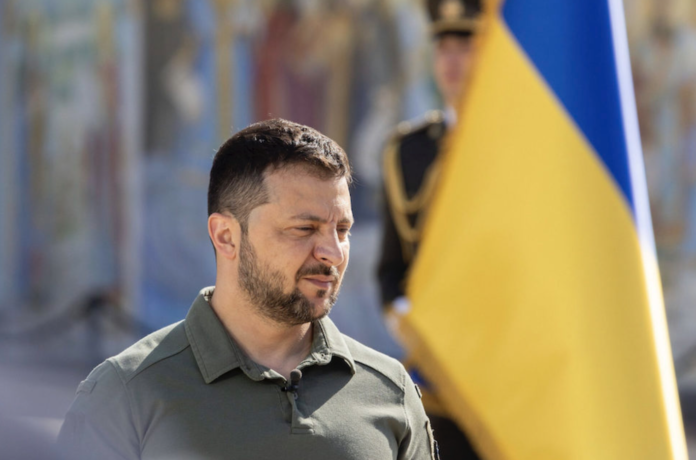
On Tuesday 18th February, President Trump shocked America’s allies when he suggested that Ukraine was responsible for starting the war that it has endured for almost three years. “You should never have started it,” he said in reference to Ukraine’s leader at a press conference. “You have a leadership now that’s allowed a war to go on that should never even happened.”
The day after falsely claiming that Ukraine started the war with Russia, Trump continued attacking their ally; “Think of it, a modestly successful comedian, Volodymyr Zelenskyy, talked the United States of America into spending $350 billion dollars, to go into a war that couldn’t be won,” Trump wrote on Truth Social. It is an acknowledged fact that Ukraine was invaded by Russia, and the United States, under Joseph R. Biden’s administration rallied behind the country, providing crucial financial aid. Yet Trump seems to be defining Ukraine President Zelenskyy as a “dictator”, stating, “He refuses to have elections. Zelenskyy better move fast or he is not going to have a country left.” Ukraine is currently operating under a martial law declaration, as it is unsafe to hold an election during a war, however, Zelenskyy has said he is willing to stand down if it would result in peace for Ukraine.
President Trump has previously displayed admiration of President Putin, and his own vice-president J.D. Vance, who in 2022 said that “I don’t really care what happens to Ukraine one way or the other,” went as far as to warn President Zelenskyy not to fight back. While in Congress, J.D. Vance was one of the most vocal opponents of U.S. aid to Ukraine.
In response, Zelenskyy claimed that Trump was “caught in a web of disinformation,”
Vance told The Daily Mail that his [Zelenskyy’s] comments would only backfire: “The idea that Zelenskyy is going to change the president’s mind by bad-mouthing him in public media is an atrocious way to deal with this administration.”
President Trump’s America also appears to be taking on the role of a major negotiator in the Russia-Ukraine War. Trump announced he spoke with Russian president Vladimir Putin on Wednesday 12th February, effectively putting an end to the West’s attempts to isolate Russia since its full-scale invasion of Ukraine in 2022. Ukrainian President Volodymyr Zelenskyy said he spoke with Trump afterwards.
Trump later met with Putin in Riyadh, Saudi Arabia, for arranged negotiations. Present was Secretary of State Marco Rubio, National Security Advisor Michael Walz and Middle East Envoy Steve Witkoff, however, Trump excluded Ukraine from the discussions. Fox News reports that the meeting in Saudi Arabia resulted in a three-stage plan, consisting of a plan for a ceasefire, elections in Ukraine and final peace agreements. The U.S. president appears eager to see the war come to an end, and amid recent events, sparks fear that it could come at Ukraine’s expense.
When asked if he would be willing to budge on Ukraine joining NATO at an Oval Office Meeting with UK Prime Minister Keir Starmer, Trump said “It’s not going to happen,” and “That’s what started this whole thing.”
United States Defence Secretary Pete Hegseth also announced during a NATO meeting in Brussels on 12th February that it was unrealistic for Ukraine to join NATO, or regain territory lost from 2014. “Returning to Ukraine’s pre-2014 borders is an unrealistic objective. The United States does not believe that NATO membership for Ukraine is a realistic outcome of a negotiated settlement.”
Questions have been raised regarding whether Trump is willing to concede much to Russia, such as occupied Ukrainian territory, and with prospects trending toward the likelihood that Ukraine will not be able to join NATO, this comes as a huge strategic victory for Russia.
