

by Luccas Ellery
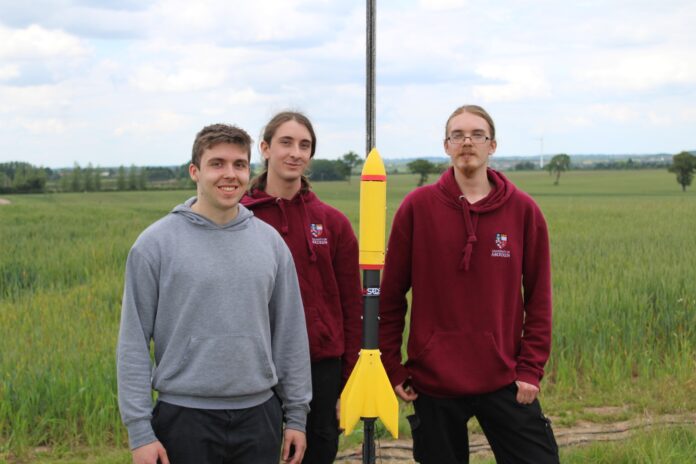
Launching a rocket to 350 metres with a maximum velocity of 190 mph is no easy task – but in June this year, Aberdeen’s rocketry society came 9th place in the UK’s National Rocketry Championship (NRC) with such a feat. The rocket in question was about one metre tall and was primarily made from carbon fibre and 3D printed parts. The vessel’s passengers included a small brick smartphone and a commercial flight computer, which were both used to record data and keep communications with ground control during the rocket’s flight.
The NRC is the biggest university-level rocketry competition in the UK, and this year, they hosted their first in-person competition at the Midland Rocketry Club just outside Birmingham, attracting 21 teams. This was also our university’s debut in the competition, making our ninth place finish a remarkable achievement.
Like many other societies at the university, the Rocketry Society got hit fairly hard during the pandemic and had to be completely rebuilt from scratch. Over the last four years, students have worked hard to turn it from a side project for just four friends into a much larger society with about 20 active members. These members contribute to launches by designing and building rockets as well as supporting electronics, software, and administrative needs. Our performance at this recent competition was a positive sign of how much the society’s grown over the past few years as well as an indicator of its future potential.
Aberdeen’s rocket had some unique features which made it stand out from the crowd. First was the fins, which were put on at a slight angle to help create spin. This setup helped to stabilize the rocket during takeoff and used centrifugal force to push the parachute out once it was released. This is the same principle as when you spin a plastic bottle attached to a string around yourself and the bottle is pushed away from you. Consequently, instead of a typical ejection charge from the nose cone for parachute deployment, Aberdeen’s rocket had a mechanical side-door system that allowed the parachute to exit from the rocket’s body. Unlike other teams, Aberdeen also used lighter foaming PLA, instead of regular PLA for the 3D printed parts, which significantly reduced the rocket’s weight.
The society is also developing a custom a flight computer, which would help us better control the rocket and get an edge over most other clubs that use commercial, off-the-shelf flight computers. On top of this, if approved by UKRA (the body responsible for authorizing UK rocketry launch sites, flight computers, etc.), other teams would be able to use this flight computer, which could prove useful for the society in terms of collaboration and reputation.
Members found the NRC an enriching experience, with them learning more about launch procedures, UKRA, and more generally about what it takes to launch a rocket at an event like this. They also gained valuable insights into time management and also gained a lot from networking with other teams and establishing contacts with key people in the field.
Among the interesting teams at the competition was UCL, who came first by implementing an innovative airbrake system. Another notable team who created a transparent rocket. Aberdeen also has plenty of other interesting stories from other competitions, like Mach 24, where one team launched a chicken schwarma into the heavens!
