

A group of healthcare workers who held weekly vigils in NHS Grampian spaces on Foresterhill campus were made to change venues after being told their vigils were ‘too political’.
One of the organisers of Aberdeen Healthcare Workers for Peace, Dr Julie McDonald, told The Gaudie that after holding vigils on NHS premises, the rules were changed.
“Following one complaint, the conditions for using hospital grounds were changed. We were told to talk about armed conflicts all across the world, which really changes the message of what we’re doing.
“It’s not that we’re unsympathetic to other causes, it’s that there has never been a targeted destruction of healthcare like what’s happening in Palestine.”
Since October 7th, 2023 over 500 Gazan healthcare workers have been killed “against the backdrop of systematic attacks on hospitals and other medical facilities in violation of the laws of war,” according to the United Nations Human Rights Office.
Chief Executive of NHS Grampian Dr Adam Coldwells confirmed the restriction telling The Gaudie he had worked with Aberdeen Healthcare Workers for Peace and attended one of their vigils. In a statement he explained:
“As an organisation serving a diverse population, as a condition for holding vigils on NHS premises I required the gatherings to be inclusive and apolitical. Workers wishing to express their feelings about any conflict across the globe could therefore be supported to attend. However, after a number of months of the group meeting, it became necessary to remind them of this stipulation. Unfortunately, they felt this was too restrictive.”
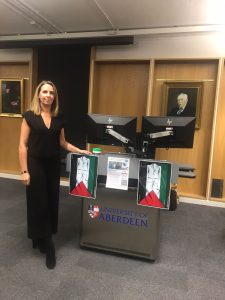
Dr McDonald confirmed this version of events, saying: “our aims were no longer aligned with NHS Grampian, so we approached the University of Aberdeen, who allowed us to use their buildings.”
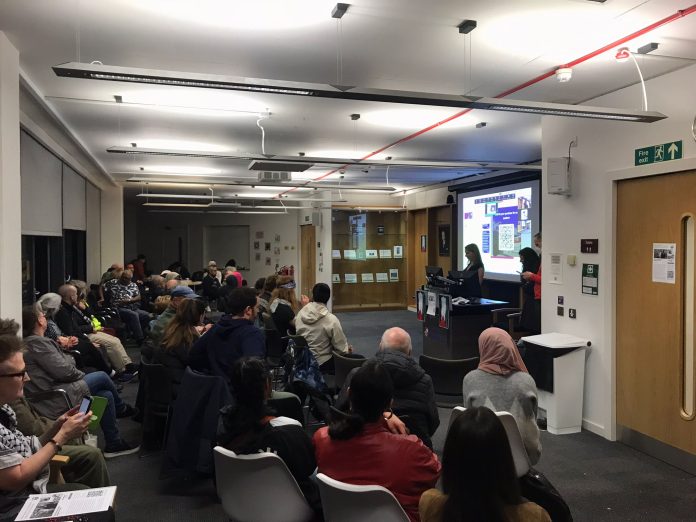
A special vigil was held in September at the University-managed Suttie Centre in Foresterhill, where Dr Akihiro Seita, a WHO representative to UNRWA, told a packed conference room that Israeli forces had targeted healthcare workers, and the extreme difficulties encountered on a recent trip to Gaza promoting Polio vaccinations.
At the vigil, Dr Iyad Abukrash video-called in from the European Hospital in Gaza. The anaesthetist described having to perform serious surgeries without painkillers, and the recent killing of his wife and daughter. The doctor hoped to evacuate his remaining daughters from Gaza. Speaking to the crowd, Dr Abukrash thanked Scottish people for their support for Palestine.
Fellow anaesthetist, Dr McDonald described her sadness at the “unimaginable situations” Palestinian colleagues faced, and “wishes [she] could do more to help.”
